
April 3, 2026 - PBS News Hour full episode
4/3/2026 | 57m 46sVideo has Closed Captions
April 3, 2026 - PBS News Hour full episode
Friday on the News Hour, a U.S. fighter jet is shot down over Iran for the first time in five weeks of war. Young conservatives share their views on the war in Iran. Plus, Palestinian residents of the occupied West Bank, including American citizens, face rising attacks from Israeli settlers.
Problems playing video? | Closed Captioning Feedback
Problems playing video? | Closed Captioning Feedback
Major corporate funding for the PBS News Hour is provided by BDO, BNSF, Consumer Cellular, American Cruise Lines, and Raymond James. Funding for the PBS NewsHour Weekend is provided by...
Support provided by:

April 3, 2026 - PBS News Hour full episode
4/3/2026 | 57m 46sVideo has Closed Captions
Friday on the News Hour, a U.S. fighter jet is shot down over Iran for the first time in five weeks of war. Young conservatives share their views on the war in Iran. Plus, Palestinian residents of the occupied West Bank, including American citizens, face rising attacks from Israeli settlers.
Problems playing video? | Closed Captioning Feedback
How to Watch PBS News Hour
PBS News Hour is available to stream on pbs.org and the free PBS App, available on iPhone, Apple TV, Android TV, Android smartphones, Amazon Fire TV, Amazon Fire Tablet, Roku, Samsung Smart TV, and Vizio.
Providing Support for PBS.org
Learn Moreabout PBS online sponsorshipAMNA NAWAZ: Good evening.
I'm Amna Nawaz.
Geoff Bennett is away.
On the "NewsHour" tonight: A U.S.
fighter jet has shot down over Iran for the first time in five weeks of war, as attacks on military and civilian infrastructure mount across the region.
Young conservatives at a Turning Point USA college event share their views on the war in Iran.
And Palestinian residents of the occupied West Bank, including American citizens, face rising attacks from Israeli settlers.
MOHAMED ABU SIYAM, Father of Nasrallah Abu Siyam (through translator): They want to take the land.
They started to expand towards the town until they became very close to the houses.
And, by the end, they have reached the boundaries of our houses, and you just can't do anything.
(BREAK) AMNA NAWAZ: Welcome to the "News Hour."
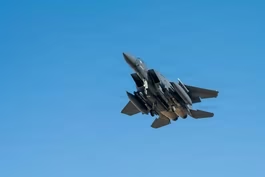
For the first time in five weeks of war with Iran, two American combat aircraft went down in separate incidents.
One of two service members on board an F-15E that was shot down was rescued.
But a military official tells the "News Hour" the whereabouts and status of the second crew member is either unknown or hasn't been disclosed.
During a harrowing rescue mission today for the fighter jet, a Black Hawk helicopter was also shot at, but was able to return to base.
And the pilot of an A-10 Warthog was reportedly rescued after being shot down as it was leaving Iran's airspace.
Stephanie Sy has our report.
STEPHANIE SY: Flying low over Southern Iran this morning, American aircraft on an urgent and risky search-and-rescue operation for U.S.
aviators shot down in their fighter jet.
Iranian state broadcasters televised a U.S.
military transport aircraft, with two helicopters following closely behind, scouring treacherous mountain terrain.
The rescue mission marks the first time since the start of the war that U.S.
troops were known to be inside Iran.
A U.S.
official confirms the down jet is an F-15.
It's the first aircraft lost in Iran since the war began.
Israel halted airstrikes during the American rescue, in which one crew member was recovered alive.
The fate of the second service member is unclear.
Iranian officials said the jet was brought down south of Tehran toward the Persian Gulf.
Iranian state media announced a bounty for the capture of the crew.
WOMAN (through translator): Residents, dear and honorable people, if you capture the enemy pilot or pilots alive and hand them over to the police, you will receive a precious prize.
STEPHANIE SY: Video from the Revolutionary Guard allegedly showed tribesmen in Khuzestan province on the hunt.
The state-affiliated broadcast showed photos of the wreckage.
The half-destroyed logo on what appears to be a stabilizer fin intact would have read "U.S.
Air Forces in Europe."
Another photo being circulated seems to show one of the crew member's ejector seats.
A second U.S.
aircraft, an A-10 Warthog similar to this one, also reportedly crashed near the Strait of Hormuz, with Iran claiming to have shot it down.
The Americans were shot down a day after President Trump touted the bombing of Iran's largest bridge.
Iran says the collapse killed at least eight people and injured nearly 100 Iranians.
Many gathered for outdoor celebrations on the last day of the Persian New Year.
A U.S.
official told PBS News that the bridge was a planned military supply route for Iran's missiles and drones, but Iranian officials said it was used only by civilians.
ABDULFAZL RAHMANI, Managing Director, Karaj Northern Freeway Construction Company (through translator): There was absolutely no military use or transportation of military equipment here and there is no military base in the vicinity.
This attack shows the ultimate savagery and hostility of the enemy.
STEPHANIE SY: President Trump warned on social media of more attacks to come, stating: "Our military hasn't even started destroying what's left in Iran, bridges, then electric power plants."
Trump's recent threats to target civilian infrastructure have raised alarms among war crimes experts.
Iran today bombarded Israel and its Gulf neighbors with missiles and drones and continued its choke hold on the Strait of Hormuz, though today a French container ship became the first Western European vessel known to have passed through the channel in recent weeks.
The ship's successful transit occurred while French President Emmanuel Macron held meetings in South Korea on jointly ensuring the safety of the strait.
EMMANUEL MACRON, French President (through translator): We addressed the crisis in the Middle East, the conditions for a de-escalation process, and the conditions in a clearly established international framework of a de-confliction being negotiated with Iran and a reopening of the Strait of Hormuz.
STEPHANIE SY: Meantime, the "News Hour" confirmed that, during the search-and-rescue mission earlier today, at least one of the military helicopters took fire.
For the "PBS News Hour," I'm Stephanie Sy.
AMNA NAWAZ: For insight on what it takes to conduct a search-and-rescue operation for a downed combat aircrew, we turn to retired Master Sergeant Wes Bryant.
He spent his career in Air Force special operations and participated in these kinds of missions.
Welcome back to the "News Hour," Wes.
Can you just tell us, based on what we know at this hour, walk us through what would be happening right now in a search-and-rescue mission.
What are they trying to do to locate and rescue this second crew member?
MASTER SGT.
WES BRYANT (RET.
), U.S.
Air Force: Well, it's twofold here.
Obviously, it's using -- prioritizing all assets available.
That's not just all air assets, but all intelligence assets, and anything we have potentially on the ground, Iranian sources, for example, people that are pro-U.S.
causes here, to locate this downed F-15 aircrew member.
And then, secondarily, it's ensuring that we have protection of air assets that are going to push into Iran.
What we have seen here is clearly the collapse of what we call air superiority.
The Trump administration, Hegseth himself, military leadership has almost, kind of in a propaganda-like manner -- not almost, but in a propaganda-like manner, told the world and the American people how much we have won in Iran, we have established dominance, we have established air superiority, there's no air defenses, there's no air force.
That's never the case in any combat environment.
And as we can see here, Iran still has sophisticated air defense capabilities.
They have to be sophisticated in order to bring down something like an F-15.
So that's twofold.
That's securing the pilot's location on the ground, and then ensuring that the assets that are going to be sent in to get that aircrew member will be safe when they get sent in.
And that's a difficult task at this point... AMNA NAWAZ: Let me ask you... MASTER SGT.
WES BRYANT (RET.
): ... because things are -- as we have been told... AMNA NAWAZ: Let me ask you, if I may, about the specifics in this case with this war in Iran, because there are examples of rescue missions for U.S.
service members behind enemy lines in other nations, right, Afghanistan more recently, earlier than that, Vietnam, Korea.
Of course, everyone remembers the infamous Black Hawk Down mission in Somalia in the early '90s.
What are the challenges here that are different from those previous episodes?
MASTER SGT.
WES BRYANT (RET.
): Well, we have really no ground forces to speak of, no partner force of any substantial nature that can push in and what we say cordon and secure an area.
In many of those cases, we had at least some kind of aligned partner forces that could help in these situations.
And then, of course, there's this -- there's a shock factor for the U.S.
military, frankly, where we don't have the superiority from an air platform standpoint that we apparently believed we did.
So now getting forces in, getting those ground components in, which are going to be a lot more at risk in low-flying helicopters, those can be shot down with rocket-propelled grenades, for example, even rifles at times.
So you don't need sophisticated air defense assets to shoot these troop carriers down.
So getting those forces in is going to be far more risk and far more difficult to plan here.
AMNA NAWAZ: We see the Iranians, of course, offering a reward for the capture of this U.S.
airmen.
If that ends up happening, if the service member ends up in the custody of Iranians or in the Iranian regime, what would that change?
What does that mean for the landscape moving forward?
MASTER SGT.
WES BRYANT (RET.
): Well, the Trump administration here, Hegseth himself, really our senior military leadership, have presented it really an utter failure to foresee the implications of this war.
I mean, it's an illegal war.
They have not foreseen the impact to regional partners here, the global instability, the regional instability, the energy crisis itself.
That's one problem of many, and then, most importantly, the incredible risk, the undue risk to U.S.
forces here.
And so I would hope that Iran wants to keep this aircrew member safe, for sake of ethics and morality and adhering to Geneva Conventions.
My guess would be that they want the leverage.
And that will be incredible leverage, because the U.S., for better or for worse, we have a very low tolerance for U.S.
casualties, and especially for U.S.
prisoners of war in the hands of a regime like the Iranian regime.
That's going to be a whole lot of leverage against the Trump administration, unfortunately.
And the most important part here is that we get our airman back safe and sound.
AMNA NAWAZ: In the minute or so I have left, you mentioned how this is a bit of a revelation in terms of what it shows us about Iran's existing capabilities.
They were able to shoot down an F-15.
It looks like also that A-10 Warthog.
They shot at a Black Hawk helicopter that was able to return safely to base.
Does all of this and could all of this change the U.S.
war effort moving forward, how operations are planned and carried out?
MASTER SGT.
WES BRYANT (RET.
): You know, I certainly hope so.
It absolutely should.
There should be a pause to operations.
Typically, with downed aircraft, down crew members, there will be a pause sometimes theater-wide, and all assets, all priorities are put to that recovery effort.
But there should also be a pause and a reassessment of what we call risk to the force, to U.S.
forces versus risk to the mission.
Continue -- we have -- the U.S.
has bombed so many targets in the last few weeks.
Making the decision to just continue forward and continue a strike campaign with a risk that we haven't properly assessed yet to our own forces would be, frankly, just incredibly irresponsible at this point.
So I hope there is a halt and a reassessment strategically and operationally here.
AMNA NAWAZ: That is Retired Master Sergeant Wes Bryant joining us tonight.
Thank you so much for your time.
We appreciate it.
MASTER SGT.
WES BRYANT (RET.
): Thank you.
AMNA NAWAZ: In the day's other headlines: President Trump is asking for $1.5 trillion in defense spending for the upcoming financial year.
That's according to details released by the White House today.
The request is more than 40 percent more than last year's spending and is the largest of its kind in decades.
The plan also includes continued funding for Trump's immigration crackdown, plus money to hire air traffic controllers and billions of dollars for beautification projects in Washington, D.C.
The plan would also cut funding for things like renewable energy projects, housing and health programs.
The budget now goes to Congress for consideration, but, on its own, it offers a blueprint for the president's priorities moving forward.
March was a surprisingly strong month for the U.S.
jobs market, even as soaring energy prices from the war in Iran had many Americans on edge.
The Labor Department said today that employers added 178,000 new jobs last month.
That's about triple what many economists had expected and comes after a loss of 133,000 jobs in February.
The unemployment rate also dipped slightly to 4.3 percent, though uncertainty about the longer-term impacts of the war is casting a shadow over the broader jobs outlook.
Ukrainian officials say that massive Russian airstrikes today killed at least eight people in what President Volodymyr Zelenskyy denounced as an Easter escalation.
Outside of Kyiv, a Russian drone set an apartment block on fire, while, in Northwestern Ukraine, local authorities say another attack damaged several buildings and killed at least one.
Ukrainian officials claim that Russia's recent use of daytime attacks is meant to increase the risk to civilians.
For its part, Russia's Defense Ministry says that at least 192 Ukrainian drones were shot down overnight, though no damage was reported.
In Cuba, the first of more than 2,000 prisoners were released today after the government issued a sweeping amnesty amid ongoing tensions with the Trump administration.
A steady stream of men and women could be seen leaving a prison outside Havana today as the results of what state TV described as a -- quote -- "humanitarian and sovereign gesture" by officials.
Few details were provided about the identities of the released or what crimes they are accused of committing.
For those walking free, it was a day to celebrate.
JOSE ANGEL CALDERON, Released Prisoner (through translator): We received the news this morning.
They called our names from a list.
I am happy and overjoyed to be able to share this news with my mother.
HAROLD BAEZ, Released Prisoner (through translator): I'm thankful for this gesture, as it gives the opportunity to rebuild my life and rejoin society.
AMNA NAWAZ: The release comes as the country grapples with an ongoing economic crisis made worse by the Trump administration's limited oil blockade.
The arrival this week of a shipment of Russian oil allowed by the U.S.
is providing some relief, and Moscow says another tanker is being sent soon.
The Artemis II astronauts are zooming closer to the moon, and their view along the way is something to behold.
NASA released the first images of Earth taken by the crew.
In this one, our blue planet peeks through one of the capsule windows, and, in another, the globe in all its glory.
NASA said the Northern Lights were visible, and that white glow is the sun being eclipsed by the Earth.
REID WISEMAN, Artemis II Mission Commander: You can see the entire globe from pole to pole.
AMNA NAWAZ: Last night, mission commander Reid Wiseman said the site stopped the four-member crew in their tracks.
They should fly by the moon by Monday.
Back on Earth, NASA officials said the mission is going well and called it an important stepping-stone for future moon flights.
JUDD FRIELING, Flight Director, Artemis II: We're going back to the moon.
We're going to stay there, right?
And so this is the first step towards that.
We will obviously build upon that.
We will get eyes on the moon, kind of map it out, and then continue to go back, and in force.
AMNA NAWAZ: Those lunar aspirations come despite plans by the White House to trim NASA's budget.
Officials are proposing a $5.6 billion cut next year.
That's 23 percent below this year's spending.
Wall Street was closed today for Good Friday after a rough few weeks for stocks due to the Iran war.
Trading will resume on Monday.
In the meantime, in Rome today, Pope Leo marked Good Friday by carrying a cross through all 14 stations of the Way of the Cross at the Colosseum.
He is the first pope to do so in decades.
For Christians, Good Friday commemorates the crucifixion and death of Jesus.
Events are held around the world, like this procession and reenactment in Germany.
In Kenya, thousands turned out for a similar event on the streets of Nairobi, while, in New York, parishioners carried a cross over the Brooklyn Bridge as part of commemorations there.
Still to come on the "News Hour": Palestinians in the occupied West Bank face rising violence from Israeli settlers; David Brooks and Jonathan Capehart weigh in on the week's political headlines; and some candymakers quietly change recipes as climate change hits the cocoa industry.
The U.S.
and Israeli war with Iran has caused a rare rift among conservatives, with several influential figures on the right condemning the war in its early days.
A recent Pew Research Center poll shows that, while most Republicans do support the war, young Republicans appear to be an outlier.
Only 49 percent of those under the age of 30 say they approve of the way that President Trump has handled the conflict.
Turning Point USA, the organization founded by the late activist Charlie Kirk, has been key in organizing young conservatives, especially at their signature campus rallies.
Our White House correspondent, Liz Landers, spoke to some of them at one such event right here in Washington last night.
So, Liz, tell us about the event, who you talked to and what they had to say.
LIZ LANDERS: This was at George Washington University's campus, which is right here in the heart of Washington.
This event was a conversation between Erika Kirk and White House Press Secretary Karoline Leavitt there.
TPUSA has become a particularly powerful organizing tool for conservatives and the Republican Party.
They have more than 3,500 university campus chapters and more than 300 staffers.
So we asked attendees who were in line waiting for the event what they thought about, one month into this conflict, this war with Iran.
As you might expect, several had the president's back.
BAILEE JUSZCZYK, Student, University of Florida: I would say I confidently trust the president to handle his agenda and to handle any foreign policy affairs.
LIZ LANDERS: But others expressed opposition or even uncertainty.
LILA HARVEY, Student, George Washington University: We don't want them to have immense power that's going to hurt other people.
But the way that it went about being out may not have been the right way of giving it.
So I have been very conflicted on, like, I guess, the means of participation that we have taken part in.
OSEWE OGADA, High School Student: I aspire to join the Marines myself and I think it's very good to serve your country.
But I don't see this war as serving America's interests, not certainly -- not its economic interests, political interests, social interests.
NASEEM CRADDOCK, Student, George Washington University: We need to focus more on the United States first.
I think there's a lot of problems that could be solved in the United States before going into foreign conflict.
To be honest, I think this was more Israel's fight than the United States.
LIZ LANDERS: Under that last student there, Naseem, he's Iranian American.
So he said that this is a complex issue for him.
He has complicated feelings about it.
But he said that he thought it was good that the ayatollah was killed.
And he said that his family also felt like they had -- there was no tears, as he put it, that the ayatollah had been killed at the beginning of this conflict.
But, as you heard him say there, he also wants the focus to be back on domestic issues in the U.S.
I asked him if this conflict, this war was going to impact his vote come November.
He said probably not, but it's other issues that are going to more personally impact him that he's focused on.
AMNA NAWAZ: That's interesting.
Well, this being right there in the heart of the G.W.
campus, I know you spoke to other students who weren't there for the event, but who also said that they oppose the war.
What did you hear from them?
LIZ LANDERS: We walked by two young women who were milling about, walking around on campus in between classes.
And they said that they were both unhappy that TPUSA was there and also were in opposition to this conflict with Iran.
Take a listen to what Gabby told us.
GABRIELA ANDREWS, Student, George Washington University: We're committing more crimes and it's being used, our dollars that we don't have.
We're both full Pell Grant students who are here completely on financial aid.
She doesn't have any right now.
Mine is being cut.
I'm deeply ashamed right now to be an American.
LIZ LANDERS: Gabby said that she watched President Trump's speech on Wednesday night.
And she said that she was particularly offended by the phrase that he used that he was going to bomb Iran back to the Stone Ages.
She said that she thought that that was appalling.
AMNA NAWAZ: Well, as you know, U.S.
viewpoints on the Middle East have changed a lot over the years.
Polls have shown young Democrats are increasingly less sympathetic towards Israel.
But they're also starting to show a similar trend among young Republicans.
What have you found out about that when you talk to experts?
LIZ LANDERS: We spoke with Shibley Telhami.
He's a professor at the University of Maryland.
And he also has been tracking and polling these issues with young voters for years now.
He points to the war in Gaza in 2023 as a real important time stamp for when these shifting views on Israel started to come to more of the forefront, especially with Democrats and also these young Republicans.
Listen to what he told us.
SHIBLEY TELHAMI, University of Maryland: We have seen the gap between younger and older Republicans became huge, particularly in terms of justifying what Israel was doing in Gaza.
And that has increased of late, particularly with regard to the Iran war, in large part because many of the podcasters and the commentary on the right, particularly the America first movement, have been highlighting the link between the Israeli aim to have war with Iran and the causes for the war, the U.S.
going to war.
LIZ LANDERS: He attributes these shifts in attitudes for young Republicans in particular to two different things.
He says, first of all, it's about the anger of the United States supporting Israel in that Gaza conflict starting several years back that started during the Biden years, honestly.
Secondly, he says that the America first platform, and you heard him talk a little bit about that at the end there, that Trump ran on, promoting domestic issues here in the United States and no more foreign war intervention.
And that was something that we heard from young people across the political spectrum yesterday, that they believed that Trump had broken that promise that he would not get the United States involved in any more foreign wars.
AMNA NAWAZ: Such an interesting look at how young voters are looking at this war.
White House correspondent Liz Landers, thank you.
LIZ LANDERS: Thanks.
AMNA NAWAZ: This week, Palestinians protested a new Israeli law that expands the death penalty for killings classified as acts of terrorism.
Human rights groups say the law is expected to apply exclusively to Palestinian prisoners in the occupied West Bank.
The U.N.
and international groups report that, as Israel and the U.S.
are waging war in Iran, there's also been a surge of violence in the West Bank, mostly by Israeli settlers against Palestinians there.
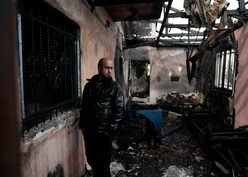
Nick Schifrin recently visited Mukhmas in the occupied West Bank to understand the nature of that violence and its impact on Palestinian families.
NICK SCHIFRIN: In the hills outside of Jerusalem, a father and uncle walk a painful path.
This is the first time that Mohamed Abu Siyam has visited his own son's grave.
Nasrallah Abu Siyam was 19 years old when he was killed six weeks ago.
Nasrallah helped build his own grave.
It was supposed to be for his grandfather.
KHALED ABU SIYAM, Uncle of Nasrallah Abu Siyam: Nasrallah told him: "I wish my day before your day, my grandfather."
At the end of the road, he's in it.
Too early, man.
NICK SCHIFRIN: Khaled Abu Siyam is Nasrallah's uncle and is American, like his nephew.
KHALED ABU SIYAM: And we all wish, all wish to use the same grave of Nasrallah.
We're proud of you.
We're proud of what you have been.
NICK SCHIFRIN: For all his life, Nasrallah Abu Siyam was an avid horse rider and teacher of his little cousins, encouraging them not to be afraid.
He led processions at local weddings.
That's him in the gray suit on his horse.
His horse's name is Shams, Arabic for sun, as in the sun that shines.
Today, the horse is still waiting for Mohamed's son.
MOHAMED ABU SIYAM, Father of Nasrallah Abu Siyam (through translator): He said: "Shams will stay with me for my whole life," and she remained.
NICK SCHIFRIN: She still remains without her rider.
This small town is more than 80 percent American.
But they say Israel's wars in Iran, Gaza and Lebanon have made them as vulnerable as any Palestinians.
ANWAR MUSTAFA, Friend of Nasrallah Abu Siyam: All people story, you know, every day in a different town.
They just don't care.
NICK SCHIFRIN: Anwar Mustafa (ph) is 57 and also American.
He and Nasrallah's other friends visit his grave to support a Palestinian community and family that feels under siege.
ANWAR MUSTAFA: Every town, they try to kick us out of our towns.
They came to kill that day.
They came to kill.
NICK SCHIFRIN: On February 18, residents say these Jewish settlers arrived on the high ground, some of them armed.
They stole the Palestinians' livestock, which provides their lively hoods.
And down the hill, Palestinians tried to hold their ground, some throwing stones.
And, suddenly, one of the Palestinians was shot.
Nasrallah tried to help.
KHALED ABU SIYAM: That's in his blood to help people.
So he couldn't not to get involved.
And him and a couple of guys trying to help this guy on the floor.
They tried just to take him away, just to save him.
And all of them get shot.
NICK SCHIFRIN: In the Abu Siyam family home, there is great grief.
They believe Nasrallah could have been saved if not for Israeli military checkpoints in the occupied West Bank.
KHALED ABU SIYAM: He lost too much blood on the way.
He was helpful until the last minute in his life.
We're never going to forget.
He tried to help people.
Now he left us.
NICK SCHIFRIN: Mukhmas' population is about 13,000.
Traditionally, many residents come here from the U.S.
for the summer, but they're increasingly staying here year-round to help protect the village.
So, can you tell us what we're looking at up there?
On the edge of town, Mohamed Abu Siyam shows me the Israeli outpost where he believes his son's killers still live.
The makeshift houses are illegal under Israeli and international law, but he says they have been there for five years.
MOHAMED ABU SIYAM (through translator): The first thing they did when they came is to build a house or two.
The army demolished the two houses.
The next day they built three and the army demolished the three.
But in around one year, they built 30 houses.
After that, the army didn't care.
NICK SCHIFRIN: In a statement provided to "PBS News Hour," the Israeli Defense Forces says its mission is to safeguard the security of all residents in the area.
And on the day Nasrallah was killed, life-endangering stone throwing occurred, and Israeli forces acted to disperse the disturbance without firing live ammunition.
Mohamed Abu Siyam says he, his father and grandfather have been shepherds on this land or nearby land for 90 years.
In the last few years, he's taken to sleeping in this shack next to a sheep to defend them from settler attacks.
MOHAMED ABU SIYAM (through translator): They want to take the land.
If you attack them or even try to talk to them, they will immediately call for police or army, and the army will come and arrest you.
So they started to expand towards the town until they became very close to the houses.
And by the end, they have reached the boundaries of our houses, and you just can't do anything.
NICK SCHIFRIN: The U.N.
and international human rights organizations say settler violence against Palestinians in the occupied West Bank has been rising.
The U.N.
says, already this year, settlers have displaced more Palestinians than in all of last year.
And since the war with Iran began, settlers have averaged six attacks on Palestinians every day.
The violence has spiked, especially since Hamas' terrorist attacks in Israel on October the 7th, 2023.
Since then, the U.N.
says settlers and soldiers have killed more than 1,000 Palestinians in the occupied West Bank, nearly one-quarter of them children under 18.
The violence drew a rare rebuke from Israeli President Isaac Herzog, who called the attacks -- quote -- "a shameful crime against innocence."
BENJAMIN NETANYAHU, Israeli Prime Minister: They're talking about a handful of kids.
NICK SCHIFRIN: On FOX News late last year, Israeli Prime Minister Benjamin Netanyahu argued that Palestinians attacked Israelis living in the occupied West Bank, but he also vowed to reduce settler crime.
BENJAMIN NETANYAHU: When they do things like chopping olive trees and sometimes they try to burn a home, I can't accept that.
That's vigilantism.
I'm taking that out.
But they claim -- they put a false symmetry between these teenagers and 1,000, actually over 1,000 terrorist attempts, terrorist attacks against the settlers.
I'm putting a special effort to stop this vigilantism.
I can't accept that, even if it's not parallel, even if it's not symmetrical.
NICK SCHIFRIN: But critics call the violence state-sanctioned.
Last month, 8-year-old Mustafa Odeh's and his 12-year-old brother, Khaled, were the only survivors of the war after Israeli border police fired at their family car.
Both their parents and two younger brothers were killed.
Last week, the Israeli Parliament passed a law that expands the death penalty for killings classified as acts of terrorism.
That will apply almost exclusively to the Israeli military's Palestinian prisoners in the occupied West Bank.
Far right National Security Minister Itamar Ben-Gvir celebrated with champagne.
The violence and displacement has helped separate and isolate Palestinian communities in the West Bank and insert Israeli outposts or legal settlements on land that Palestinians hope will be their future state.
And it's affected Palestinian communities across the West Bank, including its most rural areas.
While Palestinians describe increased violence as Israel wages war elsewhere, in villages across the West Bank, including those as small as this one, Palestinians describe decades of targeting and persecution and now violence that is unspeakable.
SUHAIB ABUALKEBASH, Victim of Israeli Settler Violence (through translator): I was 100 percent terrified.
I thought, that's it.
They will kill me.
NICK SCHIFRIN: Suhaib Abualkebash is still suffering from that terror.
He says, last month, 20 settlers attacked his village, his family, and himself.
SUHAIB ABUALKEBASH (through translator): I was outside.
They grabbed me inside the tent and started hitting me.
They tied me, tied my legs, and my hands with zip ties.
They took my pants off and zip-tied my penis and started hitting me.
NICK SCHIFRIN: His family, his wife and children, tied together and made to watch.
And he says the settlers showed them no mercy.
SUHAIB ABUALKEBASH (through translator): Everyone was beaten, except a 4-month baby girl.
She was asleep, but everybody was beaten, all the children.
What will they understand?
What will they know about these robbers or settlers?
They were scared.
They're still children, just children.
NICK SCHIFRIN: This kind of violence is obviously very personal.
Why are you willing to talk about it to a reporter like me?
SUHAIB ABUALKEBASH (through translator): To convey my voice to the world, to tell what's happening, what they are doing to people.
NICK SCHIFRIN: And what they are doing isn't only about violence, it's about land.
This family has lived in this area for 70 years, three generations of shepherding.
The family had 400 sheep, and Abualkebash says settlers stole all of them and vowed to maintain their pressure.
SUHAIB ABUALKEBASH (through translator): They said to us: "If you will not leave from here the next day, we will come and burn you, rape your women, and we will take your children and make them live with us."
NICK SCHIFRIN: But some parents' children have already been taken and their land encroached by the very people he says, killed his son.
MOHAMED ABU SIYAM (through translator): In what world does this happen?
Someone kills your son and they say, hey, look at me, and he's not far from you.
You see him every day.
KHALED ABU SIYAM: Not leaving him alone even too.
He's coming back and forth, back and forth, the same guy, same people.
And that make him more sad, more angry.
That's killing him more.
NICK SCHIFRIN: And so, instead of justice, there is a hollowness that can never be filled.
For the "PBS News Hour," I'm Nick Schifrin in Mukhmas in the occupied West Bank.
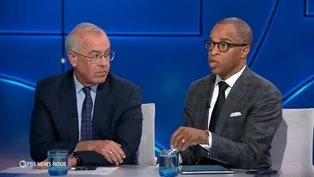
AMNA NAWAZ: For more on the political debate over the war in Iran, we turn now to the analysis of Brooks and Capehart.
That's "The Atlantic"'s David Brooks and Jonathan Capehart of MS NOW.
Great to see you both.
JONATHAN CAPEHART: Hey, Amna.
AMNA NAWAZ: So, as we sit here and speak now, as we reported at the top of the show, there's still a U.S.
crew member from that downed fighter jet missing, a search-and-rescue operation under way.
We know Iranians were also able to shoot down another aircraft over the Gulf, shot at a Black Hawk helicopter that returned to base safely.
Iranian leaders are looking for that missing crew member on the ground.
David, all of this is just two days after the president said in a dress to the nation that the U.S.
had crippled the Iranian military and the war was nearly over.
What's your reaction to all of this?
DAVID BROOKS: Yes, that's one of the disadvantages of having a huckster for president, that he does just -- he can't tell the American people that, when you're going to war, it's horrible, and that Iran is a serious country that's been preparing for this for nearly half-a-century.
And they're going to fight back and they're going to make countermoves like this or like the Straits of Hormuz.
To me, what happened -- I have been somewhat, moderately hoping there'd be some positive outcome.
And I think there has been some.
We have had go to the Middle East for almost every decade for the last 50 years because of radical Islam, which the Iranian regime typifies.
But this is clearly the week when the costs of the war are so exponentially larger than the benefits of what we're getting in these marginal weeks.
The cost to Russia is now getting all this revenue.
Iran is getting all this revenue.
The European economy and the world economies are in crisis.
NATO is in shreds.
And so the costs are just exorbitant now, not to mention the human suffering.
And so, if Trump doesn't see that we're losing every day he continues this thing, he's going to just face more and more political problems, military problems, and all sorts of problems.
And so he just needs to admit that -- what's going on.
And I doubt he has the mental ability to do that.
AMNA NAWAZ: Jonathan?
JONATHAN CAPEHART: I mean, this is a war of choice.
We didn't need to do -- take this action now.
What's funny, but not funny, playing on cable right now on a loop is "Top Gun: Maverick."
And if anyone has seen that movie, the whole plot is about a U.S.
military operation deep inside Iran, and two fighter pilots have to eject out of their planes.
I bring that up was more of a plan in the fictional plot of "Top Gun: Maverick" then there appears to be in this very real, very live situation in the United States' war with Iran.
Look, I applaud the president for finally addressing the American people, that he is a month too late, and told us nothing we had not already heard from him, from his administration through -- in various ways.
What he should have done was told the American people really why we went, how we're getting out, and then spend more than half-a-phrase on the 13 service members who lost their lives in this war of choice, his choice.
AMNA NAWAZ: Yes, David, to Jonathan's point here that those 19 minutes that the president addressed the nation, right, said this is why we're here, this is what we're there to do, there were some contradictory statements.
There are negotiations ongoing, but we're going to bomb them back to the Stone Ages.
We're winning, but there's still a lot of work to do.
Did you get clarity on what the goal of this war is from that speech?
DAVID BROOKS: I got reverse clarity.
If you go back to Trump's first book, "The Art of the Deal."
I don't think it was his first book, that early book "The Art of the Deal," he would talk about how he tries to confuse everybody by multiple different options, and I say this, I try this, I do that, it's all like a weave or a chaotic weave, as he would say.
But when you're running a war, when you're asking people to risk their lives and in some cases lose their lives, you owe some clarity to the country.
And you owe some clarity on the idea that this is what we're going to try to do.
And if he had said we're trying to make it impossible for Iran to be a regional power, that's a defined aim.
I think it's a plausible aim.
But when it shifts every day, you're not just confusing the Iranians.
Can you imagine fighting in this war and where you don't know what the president wants you to do or what the goal here is?
It's a horrible position to put anybody in.
AMNA NAWAZ: What's your take on the speech?
JONATHAN CAPEHART: Well, I think I have said a lot about the speech.
But, again, it's a month too late, quite honestly.
AMNA NAWAZ: Meanwhile, of course, all of this was delivered against the backdrop of some very tough polls for the president.
You have seen these.
A new CNN poll this week showed that roughly two-thirds of Americans say that the president's policies have worsened economic conditions in the United States.
And then there was this video, I'm sure you saw.
It was the president's remarks at a closed press event that was first posted, then later deleted, from the White House YouTube account in which he talks about some of his budget priorities.
Take a listen.
DONALD TRUMP, President of the United States: It's not possible for us to take care of day care, Medicaid, Medicare, all these individual things.
They can do it on a state basis.
You can't do it on a federal.
We have to take care of one thing, military protection.
We have to guard the country.
AMNA NAWAZ: David, we just reported today that the defense budget request from the president is $1.5 trillion, one of the largest requests in modern history.
What happened to the whole affordability message?
(LAUGHTER) DAVID BROOKS: Well, I mean, gas prices went up.
He can't -- they can't keep a model on this.
One of the things that strikes me about Trump is a basic loss of basic economic knowledge.
So, for example, in reference to the Iran war, he said it's not our problem because we don't use oil that goes through the Straits of Hormuz.
And literally that's true, but what he does not seem to understand is that global -- energy markets are global markets.
We have one global economy, and it raises prices here just as it does everywhere else around the world.
It's not like we're not being hurt.
The second thing he doesn't understand, and he's not the first president to misunderstand this, is that you can't -- it's very, very hard to create manufacturing jobs.
He promised to create manufacturing jobs.
We have lost 100,000.
Joe Biden tried to create manufacturing jobs.
I think one year Joe Biden lost 200,000.
This is a long-term trend.
China has lost tens of millions of manufacturing jobs.
as the economy moves forward, you lose manufacturing jobs.
And the idea that the tariffs and the other things were going to restore manufacturing jobs without costing Americans money at the cash register, that was always a fantasy.
And yet he just -- it's like he's living in an economic model of, I don't know, 1942 or something like that.
We live in a global economy and he does not know how it works.
And, as a result, you get these policy failures.
AMNA NAWAZ: And, Jonathan, there is so much frustration out there, right, on the economy, on a lot of other issues.
We saw a lot of that in the streets, in those massive No Kings protests that took place just a few days ago, larger attendance this time than even last time they were held.
The frustration is there.
Are Democrats doing enough to tap into it, to mobilize that?
JONATHAN CAPEHART: I would think so.
I mean, I don't know for sure.
They better be.
I think this is the fourth No Kings rally.
And, as you pointed out, each rally has been bigger than the one that preceded it.
This last one was the largest of all of them.
Put aside whether Democrats are taking advantage of all this.
What we're seeing on the streets of America are people who are angry and frustrated.
Most of them are probably Democrats.
But I wouldn't be surprised if there were some Republicans, if there were some people who voted for Trump who are not happy with the way he is conducting the economy, the war, the country.
I mean, we're talking about an administration - - a president who doesn't have any economic knowledge or his economic knowledge sort of sits firmly in the 1980s.
But you also have an administration that's filled with very rich people, billionaires, people who are saying -- one Cabinet secretary said that all people needed to have was a piece of chicken, a piece of broccoli, a tortilla and something else.
You had the commerce secretary, who is a billionaire, say, if my mother-in-law didn't get her Medicaid check or a Social Security check, she wouldn't complain.
She would just wait.
I'm sorry, you are living in a completely different world than the rest of America.
And I think the president, by saying what he said there, doesn't quite understand the people in the country that he is running.
AMNA NAWAZ: Speaking of the members of his administration, we have now seen the second Cabinet member fired in a month by the president.
The attorney general, Pam Bondi, is out after 14 months in office.
There have been a few names already floated as possible replacements, including the EPA administrator, Lee Zeldin, the U.S.
attorney in D.C., Jeanine Pirro, the deputy attorney general, Todd Blanche, senators like Eric Schmitt and Mike Lee.
David, what do you make of the decision to fire her and who do you think replaces her?
DAVID BROOKS: Our friend Ruth Marcus had a piece in "The New Yorker" today saying, of all the attorney generals in the history of America, she's the worst.
That's -- a very plausible argument could be made.
She gutted the agency.
Any lawyer with integrity or most of them, they just can't stomach this.
Her handling of the Epstein files was obviously horrendous.
And she was ineffective at doing the illegal things that Donald -- that she tried to do on behalf of Donald Trump.
And so the difference with this and the Kristi Noem firing was that Noem... AMNA NAWAZ: Former homeland security secretary.
DAVID BROOKS: Former homeland security.
One got the sense that Trump knew that the ICE policy had gone too far.
The Bondi fire, one has the sense he believes the Justice Department and the lawfare, the prosecuting political enemies, didn't go far enough.
So one assumes that he's going to pick somebody who will go farther.
And that's why I would love to see a Mike Lee, for example.
He's at least - - he's an intelligent man with an independent career.
I doubt we're going to see somebody like that.
I think we will see something wholly owned by Donald Trump, who will do whatever he wants, which is to further politicize the department.
JONATHAN CAPEHART: OK, the one person who -- I'm saying it here right now, who will not be the next attorney general of the United States is Jeanine Pirro.
AMNA NAWAZ: Why do you say that?
JONATHAN CAPEHART: Famously, the famous adage is, a prosecutor can indict a ham sandwich.
She literally could not indict a guy who threw a sandwich -- it wasn't ham, I think it was salami or something -- at a federal officer, could not indict that person.
So, no, she shouldn't be attorney general.
My money is on Deputy Attorney general, now Acting Attorney General Todd Blanche.
I don't know if he can actually get there because of legal things, but he is exactly who David is talking about, someone who is a wholly owned person.
He was the president's personal attorney through all of those... AMNA NAWAZ: Yes.
JONATHAN CAPEHART: ... his legal fights when he was no longer president, including the one where Donald Trump got convicted.
So either Todd Blanche or a member of the Senate, because that's -- those are the only two people who I could imagine could get through Senate confirmation.
AMNA NAWAZ: Well, wasn't Todd Blanche, in the 30 seconds we have left, also went down to meet with Ghislaine Maxwell in prison?
They want that coming up in a confirmation hearing, you think?
JONATHAN CAPEHART: Hey, look, Trump wants what he wants, although we don't know who he wants yet, so we will find out.
AMNA NAWAZ: We will find out.
Jonathan Capehart, David Brooks, always great to see you both.
JONATHAN CAPEHART: Thanks.
DAVID BROOKS: Good to see you.
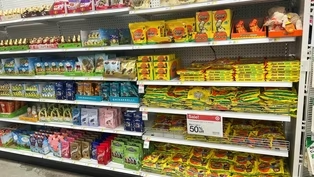
AMNA NAWAZ: Earlier this week, The Hershey Company announced that next year it's returning all of its classic brands back to earlier milk and dark chocolate recipes, impacting about 3 percent of its Reese's products.
The move comes amid a growing backlash over recipe changes and the use of chocolate alternatives in some of its candies.
Deema Zein explores what's behind this latest battle in the chocolate wars.
HYACINTH MOYA, South Dakota Resident: Kit Kats, I have literally eaten them my whole life.
When I was in high school, I used to have one of those extra large Kit Kat bars like once a week.
I would just carry it around my backpack.
DEEMA ZEIN: As a teenager, Hyacinth Moya had a serious sweet tooth, but these days she's noticed a change in the chocolate she grew up loving.
HYACINTH MOYA: The main thing is that it feels really waxy.
Yes, it just wasn't the same.
DEEMA ZEIN: And it's not just Kit Kats, says Philip Dennison, a former Snickers fan from Minnesota.
PHILIP DENNISON, Minnesota Resident: It's kind of the big name brands here in the U.S.
under like Mars and Hershey's.
We grew up eating them back in the '80s and '90s as a kid, and the flavor profile has changed.
DEEMA ZEIN: Professed chocoholic Julia Alvarado agrees.
JULIA ALVARADO, California Resident: I love Reese's Peanut Butter Cup, all those.
And, honestly, over like the last few years, I have just found myself avoiding them.
PHILIP DENNISON: It's kind of disappointing because there's that sense of nostalgia that's lost.
Like, I know what this should taste like, but it doesn't anymore.
DEEMA ZEIN: Amid a course of these disappointed customers, Hershey announced it would adjust the ingredients in some of its classic brands to include more of the costly raw ingredient that makes chocolate, chocolate, the cocoa bean.
Cocoa prices have swung sharply in recent years, driven by climate change and production issues in West Africa, where most cocoa is grown.
Prices hit a record high at the end of 2024.
And although they have fallen since, candymakers, who buy months ahead, are still feeling the impact.
RICHARD HARTEL, University of Wisconsin-Madison: Candy industries are profit-driven.
And as the cost of ingredients go up, they have got to figure out ways to either reduce costs or raise prices.
DEEMA ZEIN: Richard Hartel, a food science professor at the University of Wisconsin at Madison, has studied chocolate for 35 years and has kept records of ingredients and popular chocolate candies for more than a decade, and he's noticed some changes.
RICHARD HARTEL: Here, we have the 2015 version.
Here's the 2025 version.
They have actually reduced the amount of chocolate ingredient in the chocolate product.
DEEMA ZEIN: Last fall, a New York Times investigation found major chocolate brands were using less cocoa in their products and that popular candies like Rolo's, Almond Joy, and Mr.
Goodbar, had quietly dropped the term milk chocolate from their labels.
Under FDA guidelines, candy labeled milk chocolate must be at least 10 percent chocolate liquor, a liquid made from cocoa beans, which contains cocoa butter.
When it drops below 10 percent, companies have swapped in terms like chocolate candy and chocolate tea, a subtle shift that most consumers won't notice.
They're taking away some of that chocolate.
What are they filling it with?
RICHARD HARTEL: The standard in the industry these days is palm kernel oil, because it mimics cocoa butter's properties quite well.
We have got a bunch of chocolates here to taste.
DEEMA ZEIN: Hartel says, in taste tests, high-quality compound coatings, or chocolate alternatives, can often trick even his savvy food science students.
RICHARD HARTEL: Most people cannot tell the difference.
One article I was reading suggested that by 2050 there would be no chocolate production, no cocoa production, that all of those plantations would go away.
That's kind of kind of doomsaying, but people are looking like that, talking like that.
DEEMA ZEIN: But these tweaks to candy ingredients have sparked criticism from some unexpected corners.
BRAD REESE, Grandson of H.B.
Reese: They're really using inferior, cheap ingredients.
DEEMA ZEIN: Brad Reese has a last name chocolate lovers might know.
His grandfather H.B.
Reese, created the Reese's Peanut Butter Cup nearly a century ago, and Brad's always been an unofficial and unpaid brand ambassador.
BRAD REESE: My whole life, I have been very proud of the Reese's brand.
My Web site and my LinkedIn profile were Brad Reese Growing Reese's Worldwide One Peanut Butter Cup at a time.
DEEMA ZEIN: That changed on Valentine's Day, when Hershey's launched a new product.
BRAD REESE: The Reese's Peanut Butter Mini Hearts, I took two bites and I hadn't spit it out.
And, of course, then I dumped all the contents in the garbage and I saved the wrapper and I looked at the wrapper and realized it didn't say milk chocolate.
DEEMA ZEIN: He shared his feelings in a viral LinkedIn post, writing; "How does the Hershey company continue to position Reese's as its flagship brand, a symbol of trust, loyalty and leadership, while quietly replacing the very ingredients that built Reese's trust in the first place?"
The Hershey Company declined a request for an interview, but in a written statement to the "PBS News Hour," they said -- quote -- "Hershey is committed to making products consumers love.
And that means continually reviewing a recipes to meet evolving tastes and preferences."
It's a change Julia Alvarado welcomes.
JULIA ALVARADO: I just kind of wish that company is prioritized quality over course in a lot of situations, because you're going to lose the loyalty?
I would have stayed loyal to Hershey's, honestly, forever.
DEEMA ZEIN: She says she's willing to taste it again before confirming if it's too choco-lite for her.
For the "PBS News Hour," I'm Deema Zein.
AMNA NAWAZ: Remember, there's always a lot more online, including a look at a bill that would potentially change housing affordability nationwide.
That's at PBS.org/NewsHour.
Be sure to tune into "Washington Week" later tonight for a look at President Trump's shifting timeline for ending the Iran war.
And watch "Horizons" this weekend.
William Brangham explores the troubling rise of cancer in young adults and what's being done to counter it.
Meanwhile, on "Compass Points" this Easter weekend, Nick Schifrin and his guests discuss Pope Leo's recent pointed criticism of President Trump and the first year of the American-born pontiff's papacy.
You can find all of those on your local PBS station.
And that is the "News Hour" for tonight.
I'm Amna Nawaz.
On behalf of our entire "News Hour" team, thank you for joining us.
Have a great weekend.
 New
NewBrooks and Capehart on the cost of war and Trump's strategy
Video has Closed Captions
Brooks and Capehart on the cost of the Iran war and Trump's strategy (11m 52s)
 New
NewCandy makers change recipes as climate change hits industry
Video has Closed Captions
Candy makers quietly change recipes as climate change hits cocoa industry (5m 47s)
 New
NewHow U.S. forces conduct search and rescue for downed crews
Video has Closed Captions
How U.S. forces conduct search and rescue for a downed combat crew (6m 43s)
 New
NewNews Wrap: Trump seeking $1.5T for military spending
Video has Closed Captions
News Wrap: Trump seeking $1.5 trillion for military spending in new budget (5m 35s)
 New
NewPalestinians in West Bank face rising violence from Israelis
Video has Closed Captions
Palestinians in occupied West Bank face growing violence from Israeli settlers (10m 38s)
 New
NewU.S. fighter jet shot down over Iran
Video has Closed Captions
U.S. fighter jet shot down over Iran as strikes on infrastructure expand across Mideast (4m 21s)
 New
NewWhat young Republicans are saying about the Iran war
Video has Closed Captions
What young Republicans are saying about Trump's handling of the Iran war (5m 35s)
Providing Support for PBS.org
Learn Moreabout PBS online sponsorship
- News and Public Affairs

FRONTLINE is investigative journalism that questions, explains and changes our world.

- News and Public Affairs

Amanpour and Company features conversations with leaders and decision makers.












Support for PBS provided by:
Major corporate funding for the PBS News Hour is provided by BDO, BNSF, Consumer Cellular, American Cruise Lines, and Raymond James. Funding for the PBS NewsHour Weekend is provided by...