Here and Now
Here & Now for March 6, 2026
Season 2400 Episode 2434 | 26m 48sVideo has Closed Captions
Watch the entire episode of Here & Now for March 6.
Watch the entire episode of Here & Now for March 6.
Problems playing video? | Closed Captioning Feedback
Problems playing video? | Closed Captioning Feedback
Here and Now is a local public television program presented by PBS Wisconsin
Here and Now
Here & Now for March 6, 2026
Season 2400 Episode 2434 | 26m 48sVideo has Closed Captions
Watch the entire episode of Here & Now for March 6.
Problems playing video? | Closed Captioning Feedback
How to Watch Here and Now
Here and Now is available to stream on pbs.org and the free PBS App, available on iPhone, Apple TV, Android TV, Android smartphones, Amazon Fire TV, Amazon Fire Tablet, Roku, Samsung Smart TV, and Vizio.
Providing Support for PBS.org
Learn Moreabout PBS online sponsorship>> The following program is a PBS Wisconsin original production.
>> People in the United States do not want this war.
People are against this war.
>> Antiwar protests turn out in Wisconsin to oppose U.S.
strikes against Iran, even as many Iranian Americans embrace the military intervention, hoping for change.
I'm Frederica Freyberg.
Tonight on "Here& Now", we hear from both Wisconsin U.S.
senators on the war with Iran and exploratory drilling in the Northwoods hopes to bring metallic mining back to Wisconsin.
It's "Here& Now" for March 6th.
>> Funding for "Here& Now" is provided by the Focus Fund for Journalism and Friends of PBS Wisconsin.
>> The U.S.
war in Iraq wages on with no letup in sight.
The Wisconsin Army National Guard has more than 400 troops on the ground in Kuwait and Iraq, and were praised for their value to the mission by the U.S.
commanding general.
As to potential domestic threats, late this week, Senate Democrats once again blocked Department of Homeland Security funding, which Republicans pounced on.
We asked Wisconsin U.S.
senators about that issue and the war itself.
When we spoke with them just ahead of that DHS funding vote.
We start with Democratic Senator Tammy Baldwin.
Thanks very much for being here.
>> Thanks for having me.
>> So you voted this week in favor of a war Powers resolution to block future U.S.
military action in Iran.
It failed mostly on party lines.
But describe why you voted for it.
>> Look, first of all, Americans have been clear.
They do not want another forever war in the Middle East.
They want Congress and this president to be focused on needs at home, addressing the high cost of things like groceries, housing, child care, and health care.
And this president, in fact, promised that he would bring foreign wars to an end, not start them.
Let me be very clear.
This is a war of choice.
The US and US interests were not under attack, nor were we under imminent threat of attack.
And because of that, this is a war of choice.
And the president needed to go to Congress to get authorization.
It is an illegal war because of his failure to do that.
I voted to bring this to an end and and would note, though, that it is the proponents of this war who bear the burden of getting congressional authorization for it, and they have failed to do that.
The Constitution makes it the responsibility of Congress, who represent the people to declare war.
And that has not happened.
And instead, we are spending billions of dollars each day in this war, and we're losing the lives of our troops, including six who have lost their lives in this conflict so far.
>> You say that Iran poses a real threat.
Then why not take decisive action to thwart them?
>> I took decisive action in 2015 when I voted for the Iran nuclear deal.
I believe that this dangerous and murderous regime should never have a nuclear weapon.
And that 2015 Iran nuclear deal reined in their nuclear program.
Diplomacy is the way to address this.
Sadly, when President Trump took office in his first term, he ripped up the Iran nuclear deal and let that program continue unfettered by intrusive international inspection.
That was a very bad mistake on President Trump's part, and has led to Iran continuing with its nuclear program, its ballistic missile program.
So that's the way we rein them in is through diplomacy, hard diplomacy, but through diplomacy, not war.
>> Does it matter that the administration's justification for the strikes was changing in the early days?
>> It matters significantly that from almost hour to hour, there was a new reason why the Trump administration said it was contemplating military action and then engaging in it.
So a few weeks ago, reacting to the uprising within Iran against the regime and their economic situation, President Trump said, we're contemplating military action to support those protesters.
A few weeks later, he was talking about the nuclear program.
Then he was talking about the ballistic missile program.
Then he was talking about regime change.
What is crystal clear is that this is a war of choice, and that this administration has articulated no specific reason or strategy or exit strategy, which is something that we need to hear from this administration.
>> What are your utmost concerns about this war?
>> Look, I think that this is something that could become a regional war.
It already is.
Let's be clear in in response to to our attacks, along with the Israeli strikes, Iran has sent drones and ballistic missiles to countries all across the region.
This is exactly what this president promised to get us out of, not get us into.
And I'm very worried about the loss of life, both civilian allied troops as well as our troops, and the exorbitant expense that this will cost to have such a military operation continue on, maybe for weeks, maybe for months.
I'm very, very worried about it.
And it also means that this this president's attention is once again somewhere else.
Venezuela boats in the Pacific and Caribbean.
Now Iran, his focus is not on the concerns of Wisconsinites every day, concerns like the high cost of things and barely being able to get by.
>> What is your message to men and women from Wisconsin National Guard now serving as part of this war mission?
>> My message to those serving in theater, but also those serving their country, is thank you for your service and we will do our best to make sure that service is and make sure that the war that is ongoing becomes something that is the subject of congressional debate, so that the people of this nation, your parents, your, your families have a say in whether we continue this or not.
>> In June, when the when the US launched strikes against Iran, there was a public facing heightened threat alert for inside the US.
Now I see that the National Terrorism Advisory System says due to the lapse in federal funding, its website will not be actively managed.
What is your response to that?
>> So Democrats are moving forward to make sure that the Department of Homeland Security operations are funded, except for ICE operations and Border Patrol operations, because they have shown themselves in our neighboring state of Minnesota, as well as other states, to be acting as a rogue agencies, and they need to be reined in.
But we're offering Republicans the opportunity to fund all other activities of the Department of Homeland Security, except for Ice and Border Patrol.
>> We leave it there.
Senator Tammy Baldwin, thank you so much.
>> Thank you for having me.
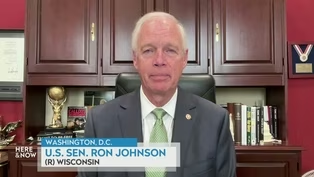
>> We turn now to Republican U.S.
Senator Ron Johnson on the war with Iran.
And, Senator, thanks very much for being here.
>> Thanks for having me on.
>> So you voted this week against a War Powers resolution to block future U.S.
military action in Iran.
It failed mostly on party lines.
But describe why you voted against it.
>> Well, first of all, we have to recognize Iran has been at war with us for 47 years in a low grade war.
But they have the the blood of hundreds, maybe thousands of Americans on their hands.
The largest state sponsor of terror.
They've declared that we are, you know, death to America, death to Israel.
They are a menace.
They threaten world peace.
They threaten regional peace.
And at some point in time, we simply weren't going to be able to deal with them.
If they became a nuclear power or they build up their, their missile inventory to such an extent that you couldn't act.
And President Trump decided this the moment to act.
You cannot have 535 commanders in chief, quite honestly, even a full blown discussion prior to the military action would have completely neutered our ability to to take the type of decisive action we've taken.
So again, the Constitution means something to me.
We have a commander in chief.
Yes.
Congress is is charged with declaring war, but we haven't declared war since World War Two.
And look at all the military interventions from both Republican and Democrat administrations.
So this is the way things are right now.
And when information really travels the speed of light, you've got to make quick decisions.
And that's why we have a a commander in chief.
>> Does it does it matter in your mind that the administration's justification for the the first days?
>> I think there's multiple reasons.
Again, you know, it's not like we declared war on Iran.
They declared war on us.
And this has just been ongoing there.
The threat has been persistent.
And at some point in time, we were going to have to act.
And good, good thing that we did act before it was too late.
>> How do you think this will progress or escalate and ultimately end?
>> Well, I think the administration, the in terms of his war aims destroy their missile capability launchers.
The missiles themselves are manufacturing capabilities, destroy their navy so they can't, you know, stop the flow of oil, make sure that they will never have a nuclear weapon.
Those those are three war aims.
President Trump is highly reluctant to put boots on the ground.
That's why he's encouraging the Iranian people.
This is the moment of the regime's weakness.
Take advantage of it.
Take back your country.
I sincerely hope Iranian people do that.
But again, this this is not he's he's not going to ensure regime change.
That's going to be up to the Iranian people.
And I hope they do, because if they do, what we will be witnessing is just historic opportunity to create far greater peace and stability, not only in the Middle East but throughout the world.
>> How concerning is it that this has spread to the entire region?
>> Well, that's Iran's doing.
I mean, that just shows what a persistent threat they are.
You know, normally if you go to war, you want to try and find allies.
They're just creating greater enemies.
So again, that just proves the point.
Iran was going to have to be taken care of at some point in time.
I guess this is that point in time.
And I for one, hope the regime falls and that the Iranian people take over Iran for the benefit of themselves.
>> How how does that work?
How do the Iranians take over their country?
>> It's going to be very difficult.
I mean, there's again, there's no guarantee whatsoever.
There's 200,000 in the Revolutionary Guard.
There's another 600,000 in their militias, the brutal militias that slaughtered 32,000 Iranians in just a few days.
You know, there were 16 or 17,000 executions in the French Revolution, 2 to 5000 executions during the Spanish Inquisition.
Just puts you puts the Iranian regime how brutal they are just in context.
So again, this is this is an evil regime.
The sooner they're gone, the better.
>> What is your message to men and women from Wisconsin now serving as part of the war mission?
>> First of all, thank you for your service and Godspeed.
It's tragic.
I mean, you know, we have a mom from Wisconsin who lost her daughter from White Bear Lake.
I mean, you read about that.
It's just it's just absolutely tragic.
So nobody, nobody wants to see these types of fatalities.
But unfortunately, that's that's what happens when you have an evil regime like Iran that threatens everybody that has to be taken care of.
>> You know, this question, is it the United States right to take out other countries rulers, even with the Ronald Reagan executive order that bans such assassinations?
>> I don't know how many times I have to point this out.
We didn't start this.
All Iran would have had to do is agree not to obtain a nuclear weapon, stop enriching uranium if they want nuclear power by the power rods, that's all they had to do.
There wouldn't have been sanctions, there wouldn't be bombs dropping.
But they refused to do that.
Take that one simple step.
And the fact that they didn't do that, as I said, speaks volumes and just shows what a menace they were.
So we we had to take them out.
And again, I do not mourn the loss of Khomeini and the people underneath him.
>> What about the way people on the other side of the aisle are talking about how it should have been diplomacy that solved this?
>> We've been we've been trying diplomacy for 47 years with Iran.
Obviously, it was never going to work.
We could not allow them.
And even the other side of the aisle will say, we can't allow them to become a nuclear power.
Well, what are we going to do to stop them?
Eventually they're going to become a nuclear power.
Then they would have been untouchable.
President Trump's prevented them from ever reaching that stage.
>> Now, the National Terrorism Advisory System says due to the lapse in federal funding, the website will not be actively managed.
So what is your response to that?
>> We ought to fund DHS.
I mean, it's incredible to me that, you know, at this moment of danger for our homeland, Democrats are still digging their heels in not funding DHS.
And the excuse they're using is they want to defund ICE.
Well, ICE is fully funded.
Ice agents are getting paychecks.
It's the other components of DHS that aren't.
And there are a lot of components, DHS, that that work to try and keep us safe.
So I think it's unconscionable.
The defund DHS.
>> All right, Senator Johnson, thank you very much.
>> Have a good day.
>> Right now in northern Wisconsin, crews are working around the clock to drill deep into the bedrock.
It's called exploratory drilling.
And the goal is to determine if a deposit of copper, gold and other minerals in the rock is rich enough to bring metallic sulfide mining back to the state.
Here and now, senior political reporter Zac Schultz has the story.
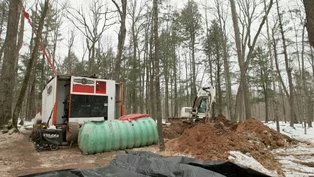
>> What we have going on here is the drilling process has just started.
>> It's a Sunday morning in the Chequamegon-nicolet National Forest in Taylor County.
A drill team out of Minnesota is making the final site preparations, digging a sump pit that will hold cuttings from the drilling that is about to begin.
Steve Donahue is on the board of directors for Greenlight Metals, the company behind the exploratory drilling.
>> And so the drill crew is getting ready to start coring the bedrock.
Okay.
And that's a hollow barrel with a diamond impregnated tip on it.
And it just cuts out a cylinder of the rock going down.
>> The drill team will cut ten feet of bedrock.
Use this tip, called a water swivel, to pull up the core and repeat.
>> This particular hole will go down about 1500 feet.
>> Greenlight Field geologists will then box up the cores and bring them back to their facility.
>> They log the geology, process the core, cut it up into segments, send it off to a lab where the lab tests it for things like copper and gold and tellurium.
>> Greenlight metals conducted exploratory drilling at the site last summer.
>> What we're seeing is about 2 to 3% copper in the ore, or what we would call.
Or if you look at the average deposit that's being mined in the world, it's maybe half a percent.
>> The site is known as the bend deposit, and it was first identified and explored in the 1980s.
>> So each of these is a drill hole.
>> Eric Quigley is Greenlight Metals director of exploration.
A computer model shows every exploratory hole drilled at the site in the last 40 years.
>> That red represents the copper, you know, primarily the copper and gold mineralization that we've identified.
>> The current drilling is trying to expand the picture to see if the deposit runs deeper than previously known.
The cores from last summer were promising.
They used a red marker to circle flecks of gold in the bedrock.
>> The visible gold within, I think, is about roughly two meters, probably averaging about a third a third of an ounce per ton, which is extremely, extremely high grade material.
>> They have conservative projections of what's in the bend deposit.
>> 4 million tons of ore, copper grade ore that was about 1 to 2% copper with good grades of gold.
And now we're finding tellurium in there.
What we're hoping to do is to expand the tonnage of that by drilling other areas around this deposit.
>> The results were enough for Greenlight Metals to secure another $11 million in funding from investors to continue the exploratory drilling.
But that doesn't mean a mine is coming to Taylor County in the immediate future.
>> So we're years away from ever from being at the point where we would actually start the permitting process with the DNR and the federal government on an actual mine out there.
>> Previous mining proposals in Wisconsin have received hostile reactions.
So Greenlight Metals is being proactive in community outreach, presenting updates to groups like the Westboro Town Board.
>> We want to be coming in and talking to you and other local units of government, because I think your input is going to be important and we want to factor that in.
The public, I would say, is about 70% enthusiastic about the potential.
And then there's another group of people who obviously have concerns about what it means for the environment.
>> I know you guys take water from the yellow River to the drilling.
What kind?
What is there in the permit that maintains a minimum flow in the yellow River?
>> The concerns are primarily focused on environmental impact.
The bend deposit is under national forest land in just a few hundred yards from the yellow River.
>> We just keep each other informed, informed about the issues.
Protecting the environment.
>> Scott Stalheim and Cathy Mauer are part of a group called friends of the yellow River.
>> I think there should not be mining in this area for a lot of those reasons.
That's my personal opinion, and I think many of the friends of the yellow River would feel that way.
>> The group is small and private, mainly focused on educating members.
An open question is whether they should become more public and vocal.
>> We had quite a few people with different opinions.
because it's just exploratory mining that, well, it doesn't matter much.
And until a real mine comes, then we'll start to worry about it.
>> I think it's a fundamentally incompatible land use to have on our national forest.
>> One group that is publicly opposing the drilling is the Wisconsin chapter of the Sierra Club.
Dave Blouin is the state mining committee chair.
>> The environment here is especially water rich, and that makes it really almost incompatible with modern mining, especially metallic sulfide mining.
>> The issue is the copper and gold are found within bedrock heavy with sulfides.
As you can see in the cores from the bend deposit.
>> There's a very stark contrast between the unmineralized rock and the heavy sulfide content.
>> After the ore is mined, it has to be processed.
Sulfides in the rock produce acid when exposed to air and water.
>> Imagine a finely ground up, almost powdery waste material that's that's left over from the processing to skim off the metals in the first place.
And you have this acid producing material that is chock full of nasty toxics that if they get into groundwater or surface waters or wetlands, are absolutely polluting and damaging to the environment.
So this includes lead, mercury, arsenic.
>> Most of the environmental damage from metallic sulfide mining comes from leaks at the tailings facilities polluting the groundwater.
>> That's an area that has gone through tremendous changes in terms of how the tailings facilities are managed.
>> This video shows the processing plant and tailings facility for the Eagle Mine, a metallic sulfide copper mine in the Upper Peninsula of Michigan.
Donohue says they don't have designs yet, but a processing facility in Wisconsin would have an engineered liner and a drainage system and would be capped at the end of its lifespan.
>> So it's very analogous to what you would see for a municipal waste landfill.
>> He also says the ore wouldn't be processed in the national forest.
Bend is one of four deposits across northern Wisconsin they would hope to mine, and the processing and tailings facility would be at one centralized location.
>> And that allows us to then capitalize, create economies of scale where we can have a pipeline of projects that over a generation or multiple generations are feeding into that operation.
>> Blouin says green light is the fourth company to explore bend, and each previous effort has shown it wasn't economically viable.
>> The overall deposit at bend is under 2% copper, meaning 98% of the material that comes out is waste.
>> Donohue says a lot has changed since the last exploration at bend.
For one, the demand for copper is up, raising the price for copper.
>> So there's a lot more demand in the system because of things like AI, electric vehicles building out the electric grid.
It's going to take a lot of copper.
>> They've also discovered a rare earth element called tellurium, labeled by the U.S.
as critical to the creation of solar panels.
>> In the drill program that was completed this past summer.
The assay data indicated about 340 350g of tellurium per ton in the material.
>> The old argument for mining in Wisconsin focused on the miner on the flag, or the need for jobs.
But the new argument is national security.
>> We're very reliant on foreign sources for many, many critical metals.
If we don't want to be dependent on adversaries for these critical metals, we're going to have to do it here domestically.
national security argument simply because bend isn't big enough to factor in.
>> In terms of the amount of minerals that ore metals that a bend deposit can produce, it's not going to dent or make any real difference in terms of national security for the United States.
>> Blouin understands any mining permit is years away, but even the exploratory drilling comes with concerns.
>> It's concerning to us because you know that potential, and they've described it as a potential mining district across northern Wisconsin is deeply concerning.
Every potential proposal results in risk to the environment, to air, to water, to habitat in multiple locations forever.
>> Donohue reiterates there's a lot more drilling and a lot of studies to go, but at some point in the future, the economics will make the bend deposit viable.
>> If you look at these types of belts across the world, this is one of the larger undeveloped belts of its type in the world.
So from that perspective, I think very confident that there will be mining again in Wisconsin.
>> Reporting from Taylor County.
I'm Zac Schultz for here.
And now.
>> For more on this and other issues facing Wisconsin, visit our website at PBS Wisconsin.
Org and then click on the news tab.
That's our program for tonight I'm Frederica Freyberg.
Have a good weekend.
>> Funding for "Here& Now" is provided by the Focus Fund for Journalism and Friends of PBS Wisconsin.
 New
NewHere & Now opening for March 6, 2026
Video has Closed Captions
Clip: S2400 Ep2434 | 58s | The introduction to the March 6, 2026 episode of Here & Now. (58s)
 New
NewUS Sen. Ron Johnson on the War with Iran and its Mission
Video has Closed Captions
Clip: S2400 Ep2434 | 7m 8s | Ron Johnson on launching strikes on Iran and the powers of Congress in waging war. (7m 8s)
 New
NewUS Sen. Tammy Baldwin on the War with Iran and its Mission
Video has Closed Captions
Clip: S2400 Ep2434 | 8m | Tammy Baldwin on launching strikes on Iran and the powers of Congress in waging war. (8m)
 New
NewThe Bend Deposit and Mining Prospects for Northern Wisconsin
Video has Closed Captions
Clip: S2400 Ep2434 | 10m 12s | GreenLight Metals is conducting exploratory drilling to assess copper in the Bend Deposit. (10m 12s)
Providing Support for PBS.org
Learn Moreabout PBS online sponsorship
- News and Public Affairs

Top journalists deliver compelling original analysis of the hour's headlines.

- News and Public Affairs

FRONTLINE is investigative journalism that questions, explains and changes our world.












Support for PBS provided by:
Here and Now is a local public television program presented by PBS Wisconsin