
May 8, 2026 - PBS News Hour full episode
5/8/2026 | 57m 46sVideo has Closed Captions
May 8, 2026 - PBS News Hour full episode
Friday on the News Hour, U.S. strikes in the Strait of Hormuz once again raise questions about the ceasefire with Iran. The latest jobs report shows stronger than expected hiring despite economic strain from the Iran war. Virginia’s Supreme Court strikes down a voter-approved referendum in the nationwide redistricting fight. Plus, the FDA commissioner is on the ropes after months of turmoil.
Problems playing video? | Closed Captioning Feedback
Problems playing video? | Closed Captioning Feedback
Major corporate funding for the PBS News Hour is provided by BDO, BNSF, Consumer Cellular, American Cruise Lines, and Raymond James. Funding for the PBS NewsHour Weekend is provided by...
May 8, 2026 - PBS News Hour full episode
5/8/2026 | 57m 46sVideo has Closed Captions
Friday on the News Hour, U.S. strikes in the Strait of Hormuz once again raise questions about the ceasefire with Iran. The latest jobs report shows stronger than expected hiring despite economic strain from the Iran war. Virginia’s Supreme Court strikes down a voter-approved referendum in the nationwide redistricting fight. Plus, the FDA commissioner is on the ropes after months of turmoil.
Problems playing video? | Closed Captioning Feedback
How to Watch PBS News Hour
PBS News Hour is available to stream on pbs.org and the free PBS App, available on iPhone, Apple TV, Android TV, Android smartphones, Amazon Fire TV, Amazon Fire Tablet, Roku, Samsung Smart TV, LG TV, and Vizio.
Providing Support for PBS.org
Learn Moreabout PBS online sponsorshipAMNA NAWAZ: Good evening.
I'm Amna Nawaz.
Geoff Bennett is away.
On the "NewsHour" tonight: The U.S.
strikes Iranian tankers in the Strait of Hormuz, once again raising questions about the cease-fire and the future of negotiations to end the war.
The latest jobs report shows stronger-than-expected hiring, despite economic strain from the war with Iran.
MOHAMED EL-ERIAN, Chief Economic Adviser, Allianz: The consumer is quite a paradox, because they say they're feeling awful, and yet they continue to spend.
AMNA NAWAZ: And Virginia's Supreme Court strikes down a voter-approved referendum in the nationwide fight to redraw congressional districts.
(BREAK) AMNA NAWAZ: Welcome to the "News Hour."
As the U.S.
and the world wait to hear if there will be diplomatic progress between the U.S.
and Iran, U.S.
fighter jets today fired on Iranian vessels in the Strait of Hormuz as part of the ongoing U.S.
blockade.
Meanwhile, Secretary of State Marco Rubio continued his visit to Rome, urging Europe to do more to reopen the strait.
Nick Schifrin reports on the day's developments.
NICK SCHIFRIN: In the Strait of Hormuz today, the moment an American fighter jet disables an Iranian tanker by striking its smokestack.
F-18s struck two empty Iranian tankers today, accusing them of trying to run the U.S.
blockade to reach Iranian ports.
In the strait, the U.S.
and Iran are in a tug-of-war, and it's pulling at the cease-fire seams.
Last night, Iran fired missiles at U.S.
warships transiting the strait, as shown in this Iranian military video.
In response, the U.S.
says it struck Iranian small boats like these and targeted launch sites and Iranian military assets in at least three locations onshore.
DONALD TRUMP, President of the United States: They trifled with us today.
We blew them away.
They trifled.
They call that a trifle.
NICK SCHIFRIN: Last night, after a driving tour of a drained Lincoln Memorial reflecting pool, the president once again threatened Iran if it didn't make a deal.
DONALD TRUMP: If there's no cease-fire, you're not going to have to know.
You're just going to have to look at one big glow coming out of Iran, and they'd better sign their agreement fast.
NICK SCHIFRIN: But, today, Iranian Foreign Minister Abbas Araghchi said threats like those make a deal less likely.
He wrote: "Every time a diplomatic solution is on the table, the U.S.
opts for a reckless military adventure.
Iranians never bow to pressure, and diplomacy is always the victim."
The ongoing diplomacy is over a memorandum of understanding that would open the Strait of Hormuz, cap Iran's nuclear program, and lift U.S.
sanctions on Iran and unfreeze Iranian assets.
MARCO RUBIO, U.S.
Secretary of State: We're expecting a response from them today at some point.
Their system is still highly fractured and a bit dysfunctional as well.
So that may be serving as an impediment.
I hope it's a serious offer.
NICK SCHIFRIN: Secretary of State Marco Rubio traveled to Rome to talk Iran and the transatlantic rift sparked by initial European refusals to allow bases to be used for American attacks on Iran.
MARCO RUBIO: One of the main reasons why the U.S.
is in NATO is the ability to have forces deployed in Europe that we could project to other contingencies.
And now that's no longer the case, at least when it comes to some NATO members.
That's a problem, and it has to be examined.
NICK SCHIFRIN: That examination peaked last week, when President Trump announced he would withdraw at least 5,000 troops from Germany within the next year in response to this comment by Chancellor Friedrich Merz: FRIEDRICH MERZ, German Chancellor (through translator): An entire nation is being humiliated by the Iranian leadership, especially by these so-called Revolutionary Guards.
NICK SCHIFRIN: Today, Rubio played nice for the cameras and released positive statements about his meetings.
And Italian Foreign Minister Antonio Tajani appealed to a historic partnership.
ANTONIO TAJANI, Italian Foreign Minister (through translator): I'm convinced that Europe needs America.
Italy needs America.
But also the United States needs Europe and Italy.
NICK SCHIFRIN: Europeans are developing a plan to help keep the Strait of Hormuz open, but only after the war ends.
And, today, some 1,600 ships in the strait are still stuck, waiting for any progress toward a deal.
For the "PBS News Hour," I'm Nick Schifrin.
AMNA NAWAZ: The Labor Department reported today that unemployment held steady in April and that the U.S.
added 115,000 jobs, surpassing expectations.
Both the Nasdaq and the S&P 500 touched all-time highs today on the news, which followed a number of strong earnings reports across industries.
For more on the numbers and what they tell us about the state of the U.S.
economy, we're joined by Mohamed El-Erian.
He's a professor at the Wharton School of Business and chief economic adviser at Allianz.
That's a financial services company.
Welcome to the show.
Thanks for joining us.
MOHAMED EL-ERIAN, Chief Economic Adviser, Allianz: Thanks for having me.
AMNA NAWAZ: So those jobs numbers were almost double what analysts expected.
Unemployment holds at 4.3 percent.
Wages are up 3.6 percent annually.
What stands out to you from today's data?
MOHAMED EL-ERIAN: So, I think three things stood out for me.
One is the job creation, which was, as you say, double what was expected, showed a very strong demand for labor, even though we have thrown everything at this economy, but the labor market remains resilient.
Second, on the supply side, on supply of workers, there are challenges.
We saw the labor force participation come down, and we saw the labor force itself contract.
So there are challenges on the supply side, even though demand is strong.
And, finally, earnings.
Average weekly earnings were lower than expected, and that speaks to a bigger reality, which we got confirmation for yesterday, which is the share of labor in national income continues to go down and is at record low levels.
AMNA NAWAZ: You mentioned despite everything we have thrown at this economy.
And we should note, despite the war in Iran, despite energy prices surging, the tariff uncertainty, the U.S.
stock markets have been breaking a number of records recently, right?
There was 10 percent in April alone.
You did warn in a recent Financial Times piece that this can't go on forever.
You wrote in part this: "There is a geoeconomic ceiling to even this market rally, and we will get there if the war is not resolved."
So, Mr.
El-Erian, that war is now more than two months on.
The back-and-forth on whether it will end or not continues.
Where is that ceiling?
And when will we reach it?
MOHAMED EL-ERIAN: So, this article was from earlier this week, and it does note this incredible decoupling of the markets from the geoeconomic reality.
Why is that happening?
Three big reasons.
One is dominance of tech.
Five companies account for half the gains in the stock market.
So it's very much a tech story.
The second issue is that so far corporate earnings have held up, even though CEOs are warning of what's ahead.
They're very worried about household budgets.
And the third issue is, the U.S.
is the cleanest dirty shirt, if you like.
Compared to the rest of the world, we're doing better and we're attracting capital.
Can this go on forever?
No.
If this war continues, if gas prices remain at these levels, if the divergences we're seeing within the population, Wall Street versus Main Street, high-income versus low-income, if they get worse, then I suspect the stock market will have difficulty decoupling from this geoeconomic reality.
AMNA NAWAZ: Tell me more about that divergence, because another set of numbers we're looking at is the consumer sentiment report from the University of Michigan that came out today.
That hit a record low.
That's down nearly 8 percent from a year ago.
Do you see any reason why those numbers would turn around for American consumers any time soon?
MOHAMED EL-ERIAN: No.
I mean, we have had -- this is the second month of record low for consumer confidence.
This time around, it's being driven by current conditions.
Last month, it was being driven by expectations of future conditions.
So that's quite an interesting change.
And I suspect that has to do with gas prices.
But the consumer is quite a paradox, because they say they're feeling awful, and yet they continue to spend.
And the concern we have is that that cannot continue, especially among low-income households that are being hit really, really hard.
And if you look at the details of the jobs report, what we started with, you will see, for example, Black and Hispanic unemployment is getting worse, while Asians and white unemployment are staying as is or getting better.
Black unemployment is now twice the level of white unemployment.
So, within an economy that looks good at the average, we are seeing major divergences that should be of concern.
AMNA NAWAZ: While we have you, I'd love to ask you about what will be now Jerome Powell's last week as Fed chair.
It ends next week.
We know President Trump has said repeatedly that he wants to cut interest rates.
So if confirmed, I want to ask what you would expect to see from Mr.
Trump's pick to now lead the Fed, that is, Kevin Warsh.
Will you expect him to push on that front to cut rates?
MOHAMED EL-ERIAN: So the market expects no cuts well into next year.
Why?
We have got a highly divided Fed.
We have got both parts of the mandate, inflation and employment, of concern.
So Kevin Warsh, when he comes in, he's not going to be able to force his authority immediately.
I suspect we won't get a rate cut.
And there's one more complication is that Chair Powell isn't leaving the board of the Fed.
He's doing something really unusual.
He's stepping down as chair, but not leaving the board.
If you put all these conditions together, this is a Fed that will basically stay where it is for most of this year, if not well into next year.
AMNA NAWAZ: Mohamed El-Erian, thank you so much for your time.
We really appreciate it.
MOHAMED EL-ERIAN: Thank you.
My pleasure.
AMNA NAWAZ: In the day's other headlines: The Pentagon began releasing what it calls new never-before-seen files on unidentified anomalous phenomena, more commonly known as UFOs.
The files were released on the Pentagon's Web site.
They include black-and-white imagery of flying objects, government reports and transcripts from flight crews and NASA astronauts.
In one, Buzz Aldrin describes seeing a fairly bright light source during the Apollo 11 mission.
Officials say the public should draw their own conclusions on what the files mean in terms of alien life, though, critics worry the videos could be misinterpreted.
Spanish health authorities in the Canary Islands are preparing for the arrival of the cruise ship at the center of the hantavirus outbreak.
Officials say more than 140 passengers and crew will be evacuated and loaded onto buses, but only when their repatriation flights are ready.
U.S.
and U.K.
officials have said they plan to send planes to evacuate their citizens.
The ship is due to arrive in Tenerife off the coast of West Africa on Sunday.
Spain's head of emergency services says passengers will be taken to a cordoned-off area and that there will be -- quote -- "no chance" of contact with residents.
VIRGINIA BARCONES, General Director, Spanish Civil Protection and Emergencies (through translator): The most common scenario we are currently working on is that the 147 passengers will arrive without symptoms and the planes will be standard.
However, we have also requested a medicalized aircraft to ensure we are fully prepared should it be needed.
AMNA NAWAZ: But dozens of port workers are protesting the ship's arrival.
Some are worried about the spread of the virus, while others say the evacuation will disrupt their work at the port.
Officials say none of those remaining on board are symptomatic.
President Trump says Russia and Ukraine have agreed to a three-day cease-fire at his request to allow for Russia's annual Victory Day celebrations this weekend.
In a post on social media, Mr.
Trump said the truce would -- quote -- "include a suspension of all kinetic activity and also a prisoner swap of 1,000 prisoners from each country."
The Kremlin and Ukraine's president have both confirmed the agreement.
Before that, though, each side accused the other of repeatedly violating cease-fires they'd separately declared.
Russia released video today that it said showed Ukrainian strikes on a commercial aviation hub in Rostov-on-Don.
In Florida today, a jury convicted four men of conspiracy in the assassination of Haitian President Jovenel Moise in 2021.
His death plunged the Caribbean nation into political turmoil, providing an opportunity for gangs to take increasing control of the country.
The four conspirators were not accused of actually killing Moise, but rather of plotting to replace him with their own leader in a bid to enrich themselves.
They now face life in prison.
At least five others have already pleaded guilty in the conspiracy and are now serving life sentences.
ABC is accusing the Federal Communications Commission of violating its First Amendment rights.
That follows the FCC opening an inquiry into the talk show "The View" over whether it violated federal rules to provide equal airtime to political candidates.
In a filing today, the network says the FCC's actions -- quote -- "threatened to upend decades of settled law and practice and chill critical protected speech."
ABC's been a frequent target of the Trump administration, including over recent comments by comedian Jimmy Kimmel about first lady Melania Trump.
On Wall Street today, stocks posted decent gains following that reassuring jobs report.
The Dow Jones industrial average added just 12 points, so mostly flat, but the Nasdaq rallied more than 400 points to a new record.
The S&P 500 also closed out the week on a positive note.
And Pulitzer Prize-winning journalist and author Philip Caputo has died.
His 1977 memoir, "A Rumor of War," about his own service as a platoon leader in Vietnam, is considered a classic of wartime literature.
It documents in vivid detail the psychological terror of fighting a largely unseen enemy.
It was turned into a two-part CBS miniseries and explored the erosion of ethics, as soldiers, including his own, killed civilians with suspected Vietcong ties.
Caputo also wrote nearly a dozen works of fiction.
His son said he died from cancer.
Philip Caputo was 84 years old.
Meanwhile, Sir David Attenborough is marking his 100th birthday, and millions of fans and nature lovers around the world are celebrating with him, even if the famously modest television host had planned otherwise.
SIR DAVID ATTENBOROUGH, Naturalist: I had rather thought that I would celebrate my 100th birthday quietly, but it seems that many of you have had other ideas.
AMNA NAWAZ: Those plans include a two-minute tribute by the BBC on a giant screen in Central London.
There have also been museum events, special screenings and tributes from countless admirers.
For seven decades, Attenborough has brought the natural world into our homes through programs like "Life on Earth" and "Blue Planet."
He's taught us not just about nature, but also about ourselves.
SIR DAVID ATTENBOROUGH: It's really very unfair that man should have chosen the gorilla to symbolize all that is aggressive and violent, and that's the one thing that the gorilla is not and that we are.
AMNA NAWAZ: So, on this, his 100th birthday, we at the "News Hour" would like to congratulate Sir David Attenborough on making this shared planet feel a bit more familiar to us all and to say thank you.
Still to come on the "News Hour": the FDA commissioner is on the ropes after months of turmoil; the Trump administration's latest counterterrorism strategy puts a spotlight on drug cartels, but downplays right-wing extremism; and David Brooks and Ruth Marcus weigh in on the week's political headlines.
Virginia's State Supreme Court struck down a plan that would have redrawn the state's congressional maps to benefit Democrats.
In an opinion released today, a majority of the justices said a referendum passed by voters last month was unconstitutional.
It was poised to transform Virginia's maps, allowing Democrats to gain up to four House seats this fall.
Virginia's Democratic House speaker, Don Scott, decried the ruling, saying in part: "This was always about more than one election.
It was about whether the voices of the people matter and no decision can erase what Virginians made clear at the ballot box."
It is a major setback for Democrats, as both parties wage a war of mid-decade redistricting.
For more on today's ruling and the national context, I'm joined by David Wasserman of The Cook Political Report With Amy Walter.
Welcome back to the "News Hour."
Let's start with Virginia.
Just walk us briefly through the court's reasoning here.
And, also, how big a deal is this when it comes to the battle for control of the House in November?
DAVID WASSERMAN, The Cook Political Report With Amy Walter: Amna, this is a major setback for Democrats because they were counting on Virginia to counteract what Republicans have done in Texas and Florida and elsewhere.
And Virginia Democrats embarked on this effort to pass a constitutional amendment to permit the legislature to pass a Democratic gerrymander just a couple days before last fall's legislative elections.
Under Virginia's Constitution, the General Assembly has to pass a constitutional amendment not just once, but twice, once before a regularly scheduled legislative election and once after, and then send the question to voters.
Democrats went through those steps, but the Virginia Supreme Court, in this case, they found that Democrats had violated the procedure by embarking on this while early voting was already under way, and therefore not before the regularly scheduled election.
So, this is likely to cost Democrats several key seats, because Virginia Democrats would have picked up four under the map that they passed.
Now, under the current map, they still have an opportunity to pick up one or two seats, but it does make it harder for them to expand their House gains even in a favorable political environment.
AMNA NAWAZ: Dave, I want to remind people how we got here, because after last week's Supreme Court decision that further gutted the Voting Rights Act, we have seen Republicans rush to change maps in some Southern states.
Louisiana paused their primaries.
They're now drawing new maps that favor Republicans.
Tennessee's new map was signed into law yesterday.
That dissolved the state's only Black-majority district.
House Republicans in South Carolina have proposed a new map, and Republicans in Alabama have approved a new map just today.
For context, how dramatically has the legal landscape around all of this shifted?
DAVID WASSERMAN: It's shifting at a dizzying pace, and the guardrails have come off in many respects.
Increasingly, what we have is a patchwork of states playing by different rules that are all electing members of the House and really scrambling the race for a majority from year to year.
And just a few weeks ago, it appeared that the White House's strategy of pursuing a mid-decade gerrymandering war was going to backfire, because Virginia Democrats were very confident their map would pass, and we still hadn't seen the Supreme Court ruling.
We hadn't seen the map that Governor DeSantis passed in Florida.
Now, with the combination of the ruling in Louisiana versus Callais and the Virginia Supreme Court decision, Republicans are poised to pick up somewhere around six or seven seats on net from redistricting.
And, in particular, these Deep South states where Republican legislatures are dismantling Black-majority districts that had been protected by the Voting Rights Act for decades, it has pushed the nuclear button.
And we are likely to see in 2028, blue states respond by passing maximalist gerrymanders that use the rationale of Republicans targeting those Black districts in the South to eliminate the remaining Republican seats in places like California, Illinois, New York.
We are going to have a litigation-palooza for the next couple years, where both the federal courts and state courts will have to determine whether there are any limits on what parties can draw to press their partisan advantage.
AMNA NAWAZ: We should point out too this week we saw very strong protests in Tennessee this week and Alabama this morning from voters who said that they don't want these new maps to go into place.
You just mentioned all the litigation ahead.
Is there a possibility that some of these new maps that are going into place could be struck down in the same way Virginia's just was?
DAVID WASSERMAN: What we have found this cycle is, there's always another plot twist.
Just when we thought that things are settled, they're not.
And so we can't rule out that federal courts would intervene, particularly in places where Republicans are seeking to delay the election calendar to pursue these maximal gerrymanders.
And so it's possible that the Purcell principle, which for years Republicans had relied on to preserve favorable maps even when federal courts struck them down close to an election, it could work in Democrats' favor if federal courts were to say that, hey, it's too close to the election to change the rules.
So far, that hasn't happened.
And a ruling that invalidates Florida's map on the basis that it violates the state's constitutional prohibition on partisan gerrymandering is much less likely than it is in Virginia, because six of the seven members of the Florida Supreme Court are appointees of Governor DeSantis.
So Republicans are still poised to come out ahead by a modest number of seats from redistricting, even though Democrats might still be favored to retake the House majority in 2026.
AMNA NAWAZ: All right, that is David Wasserman of The Cook Political Report With Amy Walter.
Dave, thank you so much.
Good to speak with you.
DAVID WASSERMAN: Thanks, Amna.
AMNA NAWAZ: Multiple outlets are reporting that President Trump is set to fire the commissioner of the Food and Drug Administration, Marty Makary.
While that hasn't happened at this hour, all of this comes after a tumultuous tenure since his installment as FDA head last year.
Stephanie Sy has our look.
STEPHANIE SY: Amna, Dr.
Makary, a Make America Healthy Again advocate, has faced broad criticism from the White House, as well as pharmaceutical industry groups, over his handling of the agency that oversees drug and vaccine approvals.
He's also been accused of confusion at the agency and was recently the target of criticism from anti-abortion groups for not restricting access to mifepristone, a medication used for abortions.
This has all raised a lot of questions about the turmoil and the political pressure within this agency.
Liz Whyte, who covers health policy at The Wall Street Journal, joins me now with more.
Liz, a lot of media outlets are reporting this firing plan, but you broke the story.
You have written about the criticism, the pressure Makary has been facing from different angles.
In your reporting, are you seeing a sort of straw that broke the camel's back here?
With the caveat, of course, that the president could still change his mind.
LIZ ESSLEY WHYTE, The Wall Street Journal: Yes, we know a lot of the frustration with Makary's leadership has been building over time.
But we also know that, this past weekend, the president himself grew quite frustrated that he felt Marty Makary was slow-walking his agenda on flavored vapes.
And he made that frustration known.
And we saw Tuesday that, for the first time in years, the FDA approved blueberry- and mango-flavored vapes.
And they have taken a number of other tobacco-related actions since then.
And we also know that, in addition, the complaints from pharmaceutical companies were also something that White House officials had in mind as they considered whether to talk to Trump about this.
STEPHANIE SY: Going back to the vape issue for a second, we should remind viewers that President Trump in his second term pledged to save vaping.
So that certainly could have been a factor.
But there's also been criticism you have written about that characterizes the FDA as overall dysfunctional under his leadership.
So describe, Liz, what was going on and what was he navigating within the agency?
LIZ ESSLEY WHYTE: Yes, the commissioner has increasingly -- increasingly relied on a small inner circle of advisers to run the agency.
He has had multiple series of conflicts with HHS and has had some conflicts with the White House as well, that we reported today that White House officials increasingly began to see him as a rogue agent, kind of marching to the beat of his own drum.
And all of those things kept piling up.
It was an issue even last year.
HHS Secretary Robert F. Kennedy Jr.
at that point had considered making Marty Makary a figurehead at the FDA and installing someone else to run the day-to-day of the agency because he was worried about his management.
They backed off of that plan, but it seems that the concerns just didn't go away.
STEPHANIE SY: And you also have, as you referenced, the pharmaceutical industry unhappy with the pace of innovative drug approvals, the pace of clinical trial approvals that they have accused the Trump administration and the FDA as shipping over to China in favor of more accelerated trials.
So talk about the influence of this pharmaceutical industry in this potential decision.
LIZ ESSLEY WHYTE: Yes, the commissioner has pledged to speed up a lot of those bureaucratic red tape things at the FDA.
He talks a lot about that, actually.
What some pharmaceutical companies, especially some smaller biotechs that have rare disease drugs, have been really upset about in recent weeks and months, though, is this series of regulatory U-turns, where they feel like they got encouraging signs and green lights from the FDA, and thus they invested a lot more in their drug development programs, and then were met with out of the blue rejections or other negative things from the FDA that ended up costing them a lot of money.
And the thought was that a lot of that was tied to Dr.
Vinay Prasad, a guy that Marty had -- Dr.
Marty Makary had hired to run the Vaccines Division at FDA.
But he's gone, and the complaints are still mounting.
And so now those companies have started to complain about Dr.
Marty Makary himself.
STEPHANIE SY: Then there's this issue of mifepristone, which we have been covering a lot on this program, in particular, that the health secretary had ordered a review of the safety of this medication used by women for medical abortions.
They did not, that review, lead to the restrictions that anti-abortion activists had hoped for.
So, Liz, when you think about Makary's tenure and this reported plan to fire him, did he have ultimately a hard time balancing politics with his role?
LIZ ESSLEY WHYTE: Yes, I mean, he definitely didn't know how to dodge these complaints.
He made explicit promises to produce this review in his early days as FDA commissioner.
But he never did.
And he was telling people inside the administration he needed a new data system to make this happen, a data system that won't be up and running until, the earliest, end of this year or early next, which is not a timeline that anti-abortion advocates wanted to hear.
In addition, he approved a generic form of mifepristone, the abortion pill.
And that really upset anti-abortion groups.
He told people that he had to legally, but he told us and we reported this that he could have slow-walked it and didn't.
STEPHANIE SY: Finally, what can we expect next?
Major changes at the FDA?
LIZ ESSLEY WHYTE: Yes, we reported that the president signed off on a plan to fire Makary.
Obviously, the president changes his mind.
And so we'd be looking to see if that gets announced in the coming days.
The White House officials will need to land on an acting official to lead the agency.
There are a couple names that have already been floated for that.
And then they will have to come up with a new nominee at the same time as they are putting forward nominees for CDC and surgeon general.
So it'll be a big, heavy lift to get those health nominees through the Senate this year.
STEPHANIE SY: That is Liz Whyte joining us from The Wall Street Journal.
Liz, thank you.
LIZ ESSLEY WHYTE: Thanks for having me.
AMNA NAWAZ: American counterterror officials are meeting today with officials from other allied nations to coordinate efforts against what the U.S.
calls deadly threats from terror groups and non-state actors.
But, as William Brangham reports, America's recently released strategy to fight terrorism contains some unusual targets.
WILLIAM BRANGHAM: Amna, the U.S.'
counterterrorism strategy, detailed in a 16-page memo released on Tuesday, identifies three main terror threats facing the U.S., narco-terrorists and transnational gangs, legacy Islamist terrorists, and violent left-wing extremists, including anarchists and anti-fascists.
That last group is later defined as those whose ideology is anti-American, radically pro-transgender and anarchist, citing, among other threats, the man accused of murdering conservative activist Charlie Kirk.
The memo makes no mention of right-wing extremist groups, despite research from the U.S.
government and others indicating those groups are responsible for the majority of violent attacks over the last years.
So, for more on America's counterterror strategy, we are joined by Colin Clarke.
He's the executive director of the Soufan Center, where he focuses on domestic and international terrorism.
Colin, thank you so much for being here.
On first blush, what is your reaction to this counterterror strategy?
COLIN CLARKE, The Soufan Center: Thanks for having me.
Well, it's about what I expected, if not a little bit subpar.
Look, there's a couple of things that it gets right, and that's the focus on hostages and wrongfully detained persons, the focus on terrorist acquisition of weapons of mass destruction, and the enduring threat posed by jihadist groups.
But it gets a lot wrong.
It gets the wrong the omission of far right terrorist groups.
It doesn't deal at all with domestic terrorism and homegrown violent extremism.
And the entire document is riddled with partisan accusations and snubs, after proclaiming to be an apolitical document, which it unfortunately is not.
WILLIAM BRANGHAM: Let's tick through some of those things.
I mentioned the three main sources it sites as threats, the first one being narco-terrorists and criminal gangs.
I mean, the administration argues that the flow of drugs into America is a clear and present danger.
What do you make of their framing of that threat?
COLIN CLARKE: Look, these groups absolutely need to be countered and combated.
Groups like the Sinaloa cartel, MS-13, and others, these are groups that are pushing crime and drugs into the United States.
But they're not terrorist groups.
They're motivated by profit, not by politics.
And so traditionally we have used law enforcement to deal with such groups.
And so when you all of a sudden start painting every single non-state actor as a terrorist group, it muddles the picture.
It confuses those that are forced to deal with this issue.
And, frankly, it takes resources away.
We live in a world of finite resources now more than ever.
And so, for the money personnel and training and expertise that goes to dealing with these groups, you have less of that to deal with other serious threats.
WILLIAM BRANGHAM: Second on that list is the threat of Islamic terrorists.
And that still seems like a legitimate threat facing the U.S.
What do you make of their strategy against those groups?
COLIN CLARKE: Well, this document is not much of a strategy.
It's actually more of a world view.
So it's very descriptive in nature.
It doesn't tell you exactly what the United States can and should do, other than a very kinetic approach.
Sebastian Gorka likes to talk about turning jihadis into -- quote, unquote -- "red mist" and this very aggressive, we will find you and we will kill you kind of tagline that he trots out.
But there's very little nuance.
There's very little substance behind that.
The document barely engages with emerging technologies and all of the tools that terrorists use as forced multipliers, including 3-D printing, artificial intelligence, unmanned aerial systems or drones, cryptocurrency, and the range of different tools that they use online, encrypted platforms, to recruit and radicalize new members.
WILLIAM BRANGHAM: We should say Sebastian Gorka is the U.S.
counterterrorism official who is believed to have authored this report.
But the third on that list was this inclusion, as I mentioned, of left-wing radicals, pro-transgender activists.
Is there any view that those groups or individuals are a substantive threat to America?
COLIN CLARKE: Look, I do think we have seen an uptick in far left violence.
Part of that is due to what we call reciprocal radicalization., As the far right has grown in this country -- and we can go back over the past few years and look at very violent attacks in Pittsburgh, Pennsylvania, where I join you today, at the Tree of Life Synagogue, at the Walmart in El Paso, at a supermarket in Buffalo, where a white supremacist targeted African American Americans.
There's been highly lethal right-wing attacks.
Any time you have a rise in the far right, you're going to have a rise in the far left.
And so we have seen an uptick in far left violence, and that uptick could continue, motivated by a range of factors, whether socioeconomic, anger over Gaza or other issues.
But, on balance and in aggregate, far right terrorism still poses a far more significant threat than the far left does.
And so to focus on one over the other and not look across the ideological spectrum comes across as cherry-picking and politicizing counterterrorism, rather than using intelligence and data-driven methods to deal with it.
WILLIAM BRANGHAM: Lastly, I couldn't help but notice, as you mentioned, that so many of the remedies here are militaristic and force-based, killing bad guys, so to speak, and no mention whatsoever of American soft power, which has been a bipartisan belief for a generation.
What do you make of that omission?
COLIN CLARKE: Well, I have to believe it was somewhat deliberate.
If you look at the DOGE cuts to USAID and others, it really pulled the mat out from under our soft power efforts, including in sub-Saharan Africa.
And so as we see a growing crisis in Mali with al-Qaida-linked groups there, the lack of funding for things to help improve governance, to help deal with border security, to help deal with all of these issues that we know contribute to the structural conditions and the drivers of radicalization, none of that is present anymore.
And so all we're left with is the kinetic option.
But if we think back to the global war on terrorism, we deal with the old adage of, are we creating more terrorists than we're killing?
And it becomes a game of Whac-A-Mole.
We tried that for two decades.
It didn't work.
In fact, it backfired spectacularly.
And, unfortunately, this document seems to be heading back into that exact direction.
WILLIAM BRANGHAM: All right, that is Colin Clarke of The Soufan Center.
Colin, thank you so much for being here.
COLIN CLARKE: Thank you.
AMNA NAWAZ: The Virginia Supreme Court's decision today to strike down a voter-approved congressional map is a major shakeup in the national redistricting battle.
To discuss that and developments in the war with Iran, we turn now to Brooks and Marcus.
That's "The Atlantic"'s David Brooks and Ruth Marcus of "The New Yorker."
Jonathan Capehart is away.
Great to see you both.
So, the Virginia Supreme Court striking down that map is a huge blow to Democrats.
Virginia Democrats are now saying they will appeal.
But I want to put to you what Governor Gavin Newsom of California, where they did change the map to benefit Democrats after voters back the move, posted this.
He listed states that now have new Republican-leaning maps, pointing out there were no votes here in Tennessee, in Florida, Missouri, North Carolina, and Texas.
He ends with this: "Virginia's voter-approved maps are thrown out.
MAGA has rigged the system."
David what do you make of that?
Are Republicans rigging the system?
DAVID BROOKS: Well, he's got a lot of company, I would say.
This is a classic case of how democracy decays.
People have always been doing gerrymandering.
It started getting worse in the 2010s, 2020s, when you had states like North Carolina, Maryland, Illinois, Wisconsin, Pennsylvania.
These had totally rigged maps.
But the inhibition -- and they were Democrat and Republican.
The inhibition was, you only did it on the census, did it once every 10 years.
So there was some constraint.
Trump blew through that restraint.
And now you can redistrict whenever the hell you want to.
And that's what Texas did.
That's what Gavin Newsom did.
Only honorable Indiana has restrained, but most of the others are doing it.
And now we are stuck in a pseudo-democracy, where voters, when voting for House candidates, do not in most cases have the actual power to throw out a party that's doing badly.
And so that democratic check is more or less gone.
There are very few swing seats.
So an election is not going to swing very far either way.
And we're probably locked in at least for the near future with a 50/50 House, whoever happens to win control.
And that itself is self-polarizing, because the parties just stay unified and never cross lines when they got 51 percent or 49 percent.
And so this is just how democracy ends.
And what we need -- Ruth, my constitutional lawyer, will tell us how to do this.
We need some sort of constitutional amendment, so this is taken out of the democratic process.
Like the Federal Reserve, let somebody else do it.
Let Jerome Powell come in and redistrict.
But we can't live with this system.
AMNA NAWAZ: Ruth, how democracy ends.
RUTH MARCUS, "The New Yorker": I thought I was going to be the gloomy one here.
(LAUGHTER) RUTH MARCUS: I have been outdone.
This was a terrible week for democracy.
And I'm just going to add a few points to everything that David said, which I agree with.
Number one, you mentioned Indiana.
Indiana was the only state that -- where Republicans stood up to the pressure to redistrict and redistrict in the middle of the cycle.
What happened in Indiana this week?
Donald Trump financed and fueled the effort to throw the lawmakers, Republican lawmakers, who bravely stood up.
They lost their legislative seats.
You said that Virginia is going to appeal.
Good luck with that.
This is the Virginia Supreme Court interpreting the Virginia Constitution.
They might find some way to get into federal court, but they're not going to get out of it successfully.
And so we are stuck in this terrible cycle.
Nobody should feel good about what Virginia did.
Nobody should feel good about what California did.
But Texas went first.
Texas went first, at the urging of Donald Trump.
And we have a situation -- and it's crazy to ask Democratic states, which have tried to get the partisanship out of districting, to just sit on their hands while the system is being rigged by the other side.
We have now unleashed this never-ending and constant now, as you say, because we don't wait for a new census cycle of retribution, and not just retribution, but assault on democracy, because the fundamental point of democracy is that voters get to decide who represents them.
No longer.
AMNA NAWAZ: Well, to that point, can I just get you both to briefly weigh in on this idea, which is that some voters wanted this, right?
In Virginia, voters wanted new maps.
Does that make it different?
DAVID BROOKS: No.
They care about their party more than their country.
They care about their party more than democracy.
And that's why we take things sometimes out of the hands of voters.
We don't want voters setting Federal Reserve -- setting interest rates, because they will not be responsible about it.
That's no knock on other people.
We would do the same thing.
RUTH MARCUS: I don't think you're being fair to the voters here, because, look, voters in Virginia tried to institute a regime that took partisanship out of this.
Voters in California tried to institute a regime that took partisanship out of this.
But they were foiled.
And they were responding in kind, even though we don't like that.
And so I would blame -- more than voters, I would blame the Supreme Court, not for what it did last week, which was terrible and -- it's the one-two punch of this redistricting effort that was going on, combined with being unleashed by the destruction of the Voting Rights Act last week.
But even more than that, in 2019, when the Supreme Court said, oh, partisan redistricting, partisan gerrymandering, we don't like that.
It's really terrible, but we're courts.
We really can't handle it.
Goodbye.
AMNA NAWAZ: Fair to say, I think, a lot of litigation ahead.
We're going to be talking about this a lot more.
I do want to ask you both to weigh in on the latest when it comes to the Iran war.
We saw the U.S.
carrying out more strikes on Iranian vessels in the Strait of Hormuz, which remains largely closed.
David, this war is now over two months old.
We have no idea when it will end or how.
Average gas prices are up to $4.50.
National polling shows six in 10 Americans disapprove of the president's handling of the war.
I know you have argued the war was worth it to unseat a hard-line Iranian regime, but what should the president do now?
DAVID BROOKS: Yes, I would say I had skeptical hopefulness, because the Iranian regime at the beginning of the war was -- is truly evil.
But we seem to have to learn this over and over again that you can't win a war with airpower alone.
And, to me, the most significant thing that I learned this week come from a CIA report, in an assessment that's floating around now, that 70 percent of the Iranian missiles are still there, 70 percent of the launchers are still there.
The Iranian regime is able to withstand the blockade for another three or four months before real pain hits.
So, the blunt fact is whatever hopes one might have had for some sort of better Iran, this isn't working.
And I started three or four weeks ago, decided we just got to call it a defeat and get out.
And I think that's what the administration should do.
RUTH MARCUS: Well, you know they're not going to call it a defeat.
(LAUGHTER) RUTH MARCUS: But, look, voters do not like Donald Trump's war any more than they like Donald Trump's ballroom.
But if I were advising him, which I never would be doing except on PBS, I would tell him, number one, stop the bluster.
When he goes from we're going to destroy civilization to it was just a love tap and back and forth and between these things, he just loses all credibility with the American people and with the regime.
And, number two, he doesn't have to declare defeat.
He just has to declare peace his honor, even though there's not much honor to be had here.
The Iranian people are not going to be freer when this war is done with, or incursion or excursion or whatever euphemism you use.
The regime is not going to be a better regime.
It's actually going to be a more hard-line regime than the one that we started with.
And so the question is whether he can come up with something that at least looks like he's dealing with the nuclear program that he already told us he obliterated during the last war.
Good luck with that.
AMNA NAWAZ: Let's turn now to the Vatican visit by Secretary of State Marco Rubio earlier this week.
He was also in Rome today, of course, meeting with the Italian prime minister, Giorgia Meloni But he was dispatched to the Vatican.
David, as you know, largely to try to smooth things over with Pope Leo, whom the president has attacked multiple times online.
The fact that he was dispatched at all, what does that say to you?
And do you think he achieved the smoothing over of relations?
DAVID BROOKS: Well, it's better than J.D.
Vance, who was telling the pope that he should learn something about theology.
RUTH MARCUS: Be careful when you talk about theology.
DAVID BROOKS: Yes.
So I think that comment probably meant J.D.
was not going to go over there.
And there's been a general shift, if one cares about these things, within Republicans in the focus groups that I have seen and read about, where, when they're asked who do you support for 2028, almost no hands go up for J.D.
Vance, but Marco Rubio seems like a normal grownup in the room.
And it is true.
If you had asked me in 2010 or 2015, say, who are the 10 senators who are pretty good at being senators, Rubio would have been on my list.
He's a serious guy.
He had a very good staff.
He dealt with real issues.
He seems like a normal guy.
And when the mishegoss is over with Trump, he at least has a slightly better shot than somebody like J.D.
Vance, who's totally in the tank.
Having said that, I think, when the mishegoss is over -- and Ruth can explain the word.
(LAUGHTER) RUTH MARCUS: We could ask the pope.
DAVID BROOKS: We could ask the pope.
That somebody far away from Trump is going to be wanted, yes.
AMNA NAWAZ: But do you think he achieved what he set out to achieve at the Vatican?
DAVID BROOKS: I think it's OK to see them.
I mean, it was somewhat awkward, but I think it was OK, yes.
It was better than where we were two weeks ago.
AMNA NAWAZ: Better than where we were two weeks ago.
Ruth.
RUTH MARCUS: Though he did kind of bring the pope an odd gift.
He brought him a crystal football.
And the pope said something like: Wow, well, thank you, I guess.
It was along those lines.
DAVID BROOKS: It could have been a mezuzah.
That would have been bad.
(LAUGHTER) RUTH MARCUS: It could have been -- well, we got to stop this, David.
(LAUGHTER) RUTH MARCUS: I think that it was good for Rubio not to present himself there as the alternate to J.D.
Vance.
I think the president is enjoying playing them off against each other and letting them audition.
But I also think this is yet another war with -- not just with the pope, but with the first American pope, that is ill-advised on the part of Donald Trump.
And why he keeps doing it and doing it and talking about the pope as soft on crime, weak on crime and supporting nuclear weapons is crazy.
His numbers and the Republican Party's numbers with Catholics, who make up a big -- very big percentage of the vote and Republican Party support, are cratering.
And this is a pope who -- and I think I'm allowed to say this -- does not seem like he really wants to turn the other cheek when it comes to Donald Trump.
He is not pretending that the president isn't lying about him.
He doesn't mention him by name, but he says, when people say untruths, I'm going to respond.
And so I don't think this is the last makeup session that we're going to see from the Trump administration to the Vatican.
AMNA NAWAZ: I know we still have to get to midterms, only because you both mentioned 2028.
I want to ask you briefly, do you think him being dispatched says anything about the future of the Republican Party, about Marco Rubio?
DAVID BROOKS: Yes, he's the next logical choice.
But I would say 2028 is going to be the era of the mother of all vibe shifts.
I think it's going to be an era where Americans have all stripes and in all different ways say, enough.
And we saw in England this week, we could see here, where the Green Party and the Reform Party displace the previous major parties.
It won't work the same here because of our system.
But that's a sign of a country saying, enough.
RUTH MARCUS: And we came up with the Rubio slogan tonight, which is less mishegoss, which for anybody out there who doesn't know what it means, it means craziness.
AMNA NAWAZ: We will see if he chooses to adopt that or not.
Ruth Marcus, David Brooks, thank you so much.
Great to talk to you.
AMNA NAWAZ: Fifteen years ago this month, Pakistan joined other nations in congratulating the U.S.
for bringing the world's most notorious terrorist, Osama bin Laden, to justice.
But behind the veneer of their public praise, Pakistani officials were furious with the Obama administration for not notifying them before the raid.
Mark Kelton was CIA station chief in Pakistan at the time.
For the next episode of "Compass Points," he told Nick Schifrin about being called in to meet with irate Pakistani intelligence officials.
NICK SCHIFRIN: What was the level of anger from the Pakistanis?
And from your perspective, were they shocked that he had been found and killed?
MARK KELTON, Former CIA Station Chief: Yes.
Initially, it was shocked, because the president, of course, had reached out and said - - had reached out a hand and said, we can work together on this.
We're counterterrorism partners, right?
And it could have been portrayed in that way as a joint success, right?
They chose to go another direction.
And so the shock turned to anger, infringement of Pakistani sovereignty, betrayal by the agency in the United States by not telling them, embarrassment, all of that.
And I get that as an emotion.
But, frankly, as a constructive point for the relationship, it would have been better if they'd taken the president's hand and said, we can do this as a joint success.
After all, I mean, al-Qaida killed Pakistanis.
And his allies killed Pakistanis.
NICK SCHIFRIN: And it's important to note -- and I went back again, and know some of my reporting at the time.
Pakistan suffered.
I mean, 30,000 people had been killed by terrorism since 9/11.
And they felt that the U.S.
wasn't respecting them enough for their sacrifice.
MARK KELTON: Right, right, right.
And I think there was a moment where they could have said, OK, well, I understand pride is hurt and everything else.
We can go forward and solidify the relationship against a common enemy, right, resolidify, let's put it that way.
But they went another direction, so anger.
And you saw manifestations of that anger in multiple ways.
AMNA NAWAZ: And you can watch "Compass Points" this weekend here on PBS.
Check your local listings and right now on our YouTube channel or wherever you get your podcasts.
Also this weekend here on PBS, on "Horizons," William Brangham talks to menopause specialists about what we're learning and what we still don't know about that phase of life.
And, tonight on "Washington Week With The Atlantic," I will be among the panelists joining moderator Jeffrey Goldberg for a look at the state of the U.S.-Iran cease-fire and the fallout from the recent exchange of missile strikes.
And that is the "News Hour" for tonight.
I'm Amna Nawaz.
On behalf of the entire "News Hour" team, thank you for joining us, and have a great weekend.
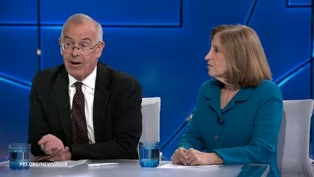
Brooks and Marcus on Virginia’s redistricting battle shakeup
Video has Closed Captions
Brooks and Marcus on Virginia’s major shakeup in the national redistricting battle (11m 56s)

Cyberattack on Canvas highlights vulnerabilities for schools
Video has Closed Captions
Cyberattack on Canvas platform highlights vulnerabilities and risks for schools (6m 43s)
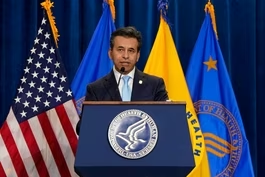
FDA Commissioner Makary on the ropes after months of turmoil
Video has Closed Captions
Why FDA Commissioner Makary is on the ropes after months of turmoil (7m 10s)
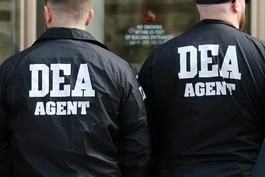
A look at new U.S. counterterror strategy’s shifting focus
Video has Closed Captions
New U.S. counterterror strategy focuses on drug cartels but omits right-wing extremism (7m 41s)

News Wrap: Pentagon releases ‘never-before-seen’ UFO files
Video has Closed Captions
News Wrap: Pentagon releases ‘never-before-seen’ UFO files on its website (6m 23s)

U.S. strikes on Iranian tankers throw diplomacy in question
Video has Closed Captions
U.S. strikes on Iranian tankers raise more questions over negotiations to end war (3m 36s)
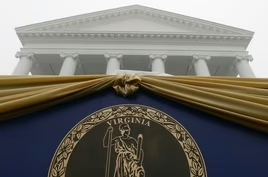
Virginia Supreme Court tosses Democrats’ redistricting plan
Video has Closed Captions
Virginia’s Supreme Court tosses voter-approved redistricting plan in blow to Democrats (6m 41s)
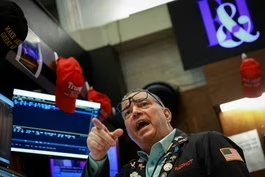
What the latest jobs numbers tell us about the economy
Video has Closed Captions
What a stronger than expected jobs report tells us about the state of the economy (6m 9s)
Providing Support for PBS.org
Learn Moreabout PBS online sponsorship
- News and Public Affairs

Today's top journalists discuss Washington's current political events and public affairs.

- News and Public Affairs

FRONTLINE is investigative journalism that questions, explains and changes our world.












Support for PBS provided by:
Major corporate funding for the PBS News Hour is provided by BDO, BNSF, Consumer Cellular, American Cruise Lines, and Raymond James. Funding for the PBS NewsHour Weekend is provided by...