Made Here
Why Did This Farm Survive VT's Extreme Floods?
Season 23 Episode 5 | 17m 8sVideo has Closed Captions
How regenerative farming helped one Vermont farm survive historic 2023 flooding.
In July 2023, historic flooding swept across Vermont, devastating farms and testing the resilience of the land. This episode follows Corie Pierce of Bread & Butter Farm as she reveals how more than a decade of regenerative farming helped their fields withstand extreme rainfall. At the heart of the story is a simple truth: the healthier the soil, the more resilient the land.
Problems playing video? | Closed Captioning Feedback
Problems playing video? | Closed Captioning Feedback
Made Here is a local public television program presented by Vermont Public
Sponsored in part by the John M. Bissell Foundation, Inc. and the Vermont Arts Council| Learn about the Made Here Fund
Made Here
Why Did This Farm Survive VT's Extreme Floods?
Season 23 Episode 5 | 17m 8sVideo has Closed Captions
In July 2023, historic flooding swept across Vermont, devastating farms and testing the resilience of the land. This episode follows Corie Pierce of Bread & Butter Farm as she reveals how more than a decade of regenerative farming helped their fields withstand extreme rainfall. At the heart of the story is a simple truth: the healthier the soil, the more resilient the land.
Problems playing video? | Closed Captioning Feedback
Where to Watch Made Here
Made Here is available to stream on pbs.org and the PBS app.
Providing Support for PBS.org
Learn Moreabout PBS online sponsorshipMore from This Collection
Explore the natural word and environment of our region.
Beneath The Surface: Journeys of Scientists and Discovery in Lake Champlain
Video has Closed Captions
Follow the personal and professional journeys of scientists working to protect Lake Champlain. (24m 50s)
Wind Power: Vermont Leads the Way
Video has Closed Captions
1941 in Vermont, the 1MW Smith-Putnam wind turbine connected to the grid. By Ian Sweet of Waterbury. (56m 21s)
The Celebration: Exploring Vermont's Wild & Scenic Rivers
Video has Closed Captions
A seven-day journey along Vermont’s Upper Missisquoi and Trout Rivers (29m 24s)
Video has Closed Captions
Vermont 4th graders raise baby trout, discovering ecosystems and connecting with nature firsthand. (15m 29s)
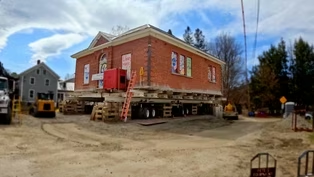
Making History: Moving the Johnson Library
Video has Closed Captions
How the Town of Johnson, Vermont got creative to save their 100 year old library from flooding. (7m 29s)
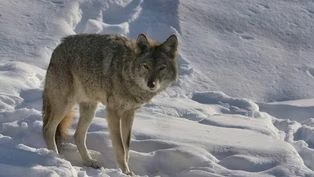
Video has Closed Captions
Investigating the eastern coyote hunting controversy in Vermont. (38m 6s)
Video has Closed Captions
In New Hampshire’s small fishing and aquaculture industries, women have broken down barriers. (45m 31s)
New Neighbors: The Beavers of Allen Brook
Video has Closed Captions
A Vermont homeowner sets out to learn about his new neighbors, the beavers. (29m 37s)
Video has Closed Captions
The story of a New England entrepreneur rehabilitating old dams to produce clean energy. (27m 42s)
Harry's - One Vermont Community and the Flood of 2023
Video has Closed Captions
Harry's Hardware in Cabot, Vermont and the flood of July 2023. (19m 45s)
Video has Closed Captions
A story of the July 2023 Vermont floods that devastated a street but not the community spirit. (37m 21s)
Defending The Dark - Preserving the night sky in Maine
Video has Closed Captions
How saving the dark sky can reduce the harmful effects of light pollution. (28m 53s)
Providing Support for PBS.org
Learn Moreabout PBS online sponsorshipIn July 2023 Vermont was hit with a couple days in a row of just massive rain, and there was flooding all over the state.
It was devastating.
Farms were hit with an extraordinary situation.
The conversation in the subsequent years has been a lot around how do we deal with these heavy rains and a lot of water?
The healthier the soil, the more resilient it is to handle extreme weather events.
Soil is truly at the baseline and the foundation of where all life comes from, and helping to encourage there to be healthy soil feels like a top priority in doing that in a way that is cyclical and regenerative.
My name is Corey Pierce and I'm the owner of bread and butter farm.
We got here in the fall of 2009 we always imagine this place to be really multifaceted, and honestly, the 23 floods showed us the resilience of just over a decade's worth of doing the kind of work that we're doing when you're working to be a Land Steward on land that has been conventionally managed and tilled for decades and decades, and soil compaction is huge and real, and fertility is low, and all of that, you've got to start with the soil.
You've got to start by building back the soil in order to do truly anything with that land being tuned in to what impacts soil health is the baseline of where we try to learn and to think and make decisions.
The healthier the soil, the more resilient it is to handle extreme weather events, especially like heavy rain.
And so what happened in 2023 with the heavy rain events was a real wake up call, I think, to a lot of people, because we were able to see where land was resilient and was able to withstand the rain and where it wasn't.
If you're looking at a really healthy soil system, you're seeing often dark organic matter.
You'll see that the soil is covered with plants growing over it.
You'll see roots moving through it, breaking any compaction that they come to you see little air pockets that are then made because of that, that are contributing to spaces where both microbes can crawl and move, and also where water will be able to infiltrate, as we have rain events, as opposed to heavily compacted and not very healthy soil.
It's dry, it's hot.
There aren't plant roots in there.
The pore spaces have been collapsed with heavy compaction that might come from machinery driving over it, or even heavy foot traffic going over it, water will go quickly through the top bit, and then it will hit a point of compaction very quickly, because there aren't those pore spaces.
And so water is not able to move through.
Many different plants, their tender little roots aren't able to move through, and seeds that might be in the soil are unable to spring to life.
So our goal on all the land that we manage is to build healthy soil everywhere, and it's going to look differently, whether you're in our pastures or whether you're in our gardens but the principles are similar.
Humans have obviously played a part in creating environmental challenges that we face, but I also think it's really important for humans to see themselves as an integral and important part of the ecosystem and their relationship to the land and to the plants and the animals and the soil, that we can have a really beautiful positive impact.
Here at the farm, we are trying to reimagine what building community around the land can be.
Where are you guys from?
I think humans have disconnected a lot from the land and also from where our food comes from.
So when I thought about having a farm that I was part of I really wanted to think about a way to bring the community to the farm too.
Our philosophy around farming is trying to mimic what we see that's actually happening in the micro ecosystems that are all over this land, while also making some choices to bring in some other new species, whether it's trees or plants or animals.
So we're raising mixed vegetables and small fruits year round, and we're also raising a cattle herd for beef and then a small pig herd for educational purposes and also for their pork, not really piglets anymore.
I. The grasslands and pasture lands, they are inextricably linked to the herbivores, the grazers of that area, and we have sadly disconnected a lot of those relationships, and so bringing back those animals is really that first line of defense for building the soil.
So we're about to move the cattle to the next paddock.
And they're moving anywhere from one to eight times a day based on the the cells that we make, or the little paddocks that we make.
And we're basically trying to mimic how this herd would move if they were a Wild Herd.
So as a Wild Herd, they would be packed up together.
They'd be coming through and grazing, and they'd basically be taking, like the top bite of grass and then trampling the rest of what's left over.
And their hooves would dig into the soil, kind of pushing down what's left over, almost like mulching it as they go.
So the relationship between the cattle and the grasses is enhanced as they're able to work together, essentially.
So the cattle are eating the grass, and the grass is able to respond to that disturbance and drive their roots deeper, and as they poop and pee, the microbes are able to build soil more deeply, and the whole system is enhanced.
Across the board, we've seen tremendous increase in the biodiversity and the water holding capacity and the organic matter in our soil in the years that we've been grazing these animals in this way.
So all in all, that symbiosis is able to withstand then more extreme weather conditions, like heavy rains, because more water is able to be absorbed by the sponge, like soil and more plants, more water is held, and more plants are only going to be there if there's healthy, rich and deep soil.
So the farm's been here since 2009 and we've gone from an average of three to five species per acre in fields we did not seed at all to over 21 species per acre.
So if you think about biodiversity and relationships, that is a dramatic increase.
All they're doing is living their lives and doing their thing, and our job is to get out of the way as much as possible and it's really cool to see what they can do when you just let them do what they do.
So they're talking because they know they see Brandon setting up the next line so they know they're about to get get fresh grass.
The moms are talking to their babies and telling them it's time to go.
a rogue cool Robbie, just say these look a little like aliens on root.
I just think they look like, they've like, levitated up out of the soil.
So this is what we call the key line garden.
We've established the beds there.
This is a bed that's a bed, here's a bed.
And the paths are permanently in these spots.
And we've intentionally planted all of these beds section after section along the contour of this hillside here.
So the key line garden is important in how it's oriented on the contour of the land.
And the best way to think about that is that as heavy rain hits the ridge of the land where the key line garden is, it will flow down the hillside there and then the natural sort of flow will then spread it out along the whole garden, these beds are kind of accepting that water and basically able to soak up more and more and more as all of the soil that you see right here is is just so rich and full of microbes and full of tons and tons of life.
The goal too with the soil is that we're disturbing it as little as possible.
So these lettuces will get harvested.
We'll leave behind a little root stump there, and we just leave that, and we let the microbes just break that down and incorporate that back into the soil.
And then we can heavily mulch this with straw or hay, and then we'll plant the next crop right into that.
So it's basically just a continuous system.
We think about soil like a giant sponge.
You know, if you have a nice giant sponge, you can soak up a lot more water.
So in the top six to 12 inches of healthy soil, with every 1% increase of soil organic matter, the soil has the ability then to hold over 20,000 more additional gallons of water per acre.
And so if we have a big flood event and there's plants growing in that soil, whether it's grasslands or whether it's our crops, the amount of water that can be absorbed is just we can't even understand what that is.
It's just a. So much more than what we can think of.
If we have a field that has been heavily compacted over and over again, there aren't roots holding that in place that is just literally going to get washed away.
You're going to get erosion.
You're going to get those gullies.
You're going to get all this beautiful, hard earned topsoil that we've been working for just washed away.
So having plants and roots is the best, holding it all in.
And then when you can't have that, having that covered.
But we're pretty much like in a race all the time to plant this out.
So like this bed right here just got just got cleared out, just got harvested.
And now we're gonna either plant it again, which we're kind of on the cusp of how much time before winter here we can get a crop, or we'll cover it with with hay mulch, and that will hold it, that'll serve as that, like holding it in place for the winter.
We can walk together.
All right, let's go to the egg garden.
This is the loofah.
Oh my gosh.
So see how it's that one squishy, like some of them are still super hard.
You can harvest them when they're green.
You just don't know if the sponge inside is going to be fully developed.
What I've learned is that you can peel this back, and that's the sponge, right, but you first have to squeeze it all out, because there's all this, like fleshy stuff that you want to get out of the sponge, and then this will all have dried out, and then you can just have this as sponges, and you don't have to buy petroleum based sponges or loofahs to exfoliate, but I feel like the kids are gonna get thrilled about processing this.
Personally, since starting the farm, I've moved more and more towards the education side of what we're doing, and I think a ton about how kids aren't as much as they were 20, 3040, years ago, just playing outside and just the challenge of competing with technology is really hard.
So the real challenge is like, how do you compel someone to step outside their house, to put the phone down, to step away from the screen and just be there and just slow down?
The best kind of learning happens when you're doing and when you're doing something that is purposeful and meaningful.
And I think for so many kids, not everybody, but so many kids actually engaging with the land and animals, it just feels so ripe for education here.
And obviously the land, in and of itself, is like a giant playground, if you allow it to be for all ages, right?
But just continuing to be thoughtful and creative about all the ways to just literally be outside and feel comfortable and engaged and really just normalize it.
It's so beautiful.
All right, you guys look up at the canopy.
I'm, like, a big believer, especially in a small scale veg operation, to do as much by hand as you can, because it gives you the time to really actually look at your plants, because if you don't take that time, you miss a lot.
What we're trying to do here is just being a prominent place in our community for people to come in many different ways, as a customer, as a kid, coming to a program or coming for a concert or event or whatever the entry point is, being able to see people working in agriculture, I think, is also really important, because you can come here and you're literally watching our crew go in and out of the greenhouses and heading out to the pastures to move the cattle.
And it's not that often that you get to do that.
Her vision for this place was always to be a community farm.
And when I first heard her say that in the beginning, I didn't totally know what that meant.
It sounded really nice to me, because I've always been drawn to community, that word and that concept, what I feel and what I sense from a lot of people who step foot on this land and in this place, it tends to feel like, oh, there's something happening here, there's something a little bit different, and that goes back to the power of an intention.
And for a seed that was planted for that when I was a kid, I always wondered why humans seemed like they needed so much extra stuff, as compared to every other animal that I saw, and our needs as a species are pretty simple, right?
We need to be nourished, we need to have shelter, we need to have love in our lives.
And how do you get that?
Where do you get that?
You literally get that from the land and from how the land supports all.
Of us around that.
And so the work needs to be done to grow the food, the work needs to be done to take care of the land.
The work needs to be done to take care of the kids, the elders and everybody in between.
Land based work has become so uncommon, which is crazy, right?
And so how do we make it more common again, and at the heart of it all is that community, tending to land and tending to each other and tending to kids require a lot of people and a lot of perspectives just even asking the question, What does it even mean to be a Land Steward?
You know, I think we should all think about that, because otherwise it's sort of like, oh, I don't, I'm not a Land Steward, so I don't really think about it.
I don't care, you know, we can pave this over and, you know, it's just like, that's a lot of where that disconnect happens.
So taking that responsibility and hoping that everybody can take some amount of responsibility to the land, to the oceans, to the waterways to the whole thing is feels Really important.
The land on which we stand is the only thing we have that can withstand the weight of our lives.
So learn to treat the land like you.
Treat your own two hands.
Honor its strength, cherish the gifts it holds.
On Earth strength, cherish the gifts it holds.












Support for PBS provided by:
Made Here is a local public television program presented by Vermont Public
Sponsored in part by the John M. Bissell Foundation, Inc. and the Vermont Arts Council| Learn about the Made Here Fund