
Democratic strategist breaks down 2024 election autopsy
Clip: 5/21/2026 | 6m 35sVideo has Closed Captions
DNC Democratic strategist breaks down DNC's 2024 election autopsy
The Democratic National Committee released a long-awaited, yet still incomplete, report into what went wrong during the 2024 presidential election. The report had initially been shelved, but after months of consternation and criticism, DNC Chair Ken Martin said he released it in the name of transparency. Geoff Bennett discussed more with Democratic strategist Faiz Shakir.
Problems playing video? | Closed Captioning Feedback
Problems playing video? | Closed Captioning Feedback
Major corporate funding for the PBS News Hour is provided by BDO, BNSF, Consumer Cellular, American Cruise Lines, and Raymond James. Funding for the PBS NewsHour Weekend is provided by...
Democratic strategist breaks down 2024 election autopsy
Clip: 5/21/2026 | 6m 35sVideo has Closed Captions
The Democratic National Committee released a long-awaited, yet still incomplete, report into what went wrong during the 2024 presidential election. The report had initially been shelved, but after months of consternation and criticism, DNC Chair Ken Martin said he released it in the name of transparency. Geoff Bennett discussed more with Democratic strategist Faiz Shakir.
Problems playing video? | Closed Captioning Feedback
Where to Watch PBS News Hour
PBS News Hour is available to stream on pbs.org and the PBS app.
Providing Support for PBS.org
Learn Moreabout PBS online sponsorshipGEOFF BENNETT: The Democratic National Committee released along the way did, yet still incomplete report into what went wrong during the 2024 presidential election.
The report had initially been shelved, but, after months of consternation and criticism, DNC Chair Ken Martin said he released it today in the name of transparency.
He also said it -- quote -- "wasn't ready for prime time" and rejected its findings, writing this: "I am not proud of this product.
It does not meet my standards and it won't meet your standards.
I am releasing the report as I received it in its entirety, unedited and unabridged with annotations for claims that couldn't be verified."
Those annotations are found throughout the 192 pages.
The report blames Joe Biden's political team for not positioning Kamala Harris for success.
It also says Democrats didn't effectively make the case against Donald Trump.
There are also omissions.
The report does not mention Mr.
Biden's age or the war in Gaza and how opposition to it may have depressed Democratic enthusiasm.
Joining us to discuss what the party got right and wrong and how to move forward into the midterm elections is Democratic strategist our friend Faiz Shakir.
Faiz, it's good to see you.
FAIZ SHAKIR, Democratic Strategist: Hi, Geoff.
GEOFF BENNETT: So, this report is riddled with errors.
There are notes saying -- quote -- "no evidence provided, analysis not supported by the data."
There's even a missing conclusion with a note saying, "This section was not provided by the author."
What do you make of the way that this was handled?
FAIZ SHAKIR: Well, it was handled poorly.
And I think, obviously, Ken would probably acknowledge that, the chairman of the DNC.
What are people looking for at this moment?
They're looking for leadership and they're looking some sense of integrity of, can you diagnose restoring the Democratic brand?
In my view, it is suffering with working-class people.
In this age of Trump, it should be booming.
The Democratic Party should be the place, the home of so many people, not only Democrats, but so many independents who are feeling disaffected.
What is the brand problem?
And I think the report is more a symptom, rather than the cause of the problems.
It's a symptom because there's a sense of unwillingness to talk about hard issues, confront difficult questions.
Let's have a debate.
Let's discuss reform.
Let's not be status quo.
And people look at this report and the process by which it is now released as saying, that's the problem.
We're walking on eggshells.
We can't even have hard questions.
Let's confront some real problems and have bold solutions to reform a broken system.
GEOFF BENNETT: There's a striking line in this report suggesting that Democrats became too dependent on what is called in this report negative partisanship, essentially asking voters to fear Republicans rather than believe in Democrats.
Is that a fair criticism?
FAIZ SHAKIR: It's still the case, Geoff.
We're still in a moment -- if you hear most Democrats talk right now, you will hear a thing like the Epstein class.
And I'm here to tell you, yes, there's an Epstein class.
They're corrupt.
Yes, but what people are hunting for is, give me a sense of a vision that isn't the Epstein class.
And when too many people are thinking, oh, the Epstein class is a version of both sides having problems, right, Democrats and Republicans.
So now the choice is, OK, if you're going to take on corruption, give me a vision.
Give me a sense of a party that's saying, oh, I'm going to expand health care in America.
Here's how.
I'm going to tax the rich.
Here's how.
I'm going to build a grassroots movement in America, find working-class people, bring them into the process, change the institutions.
People are feeling like this is the time to break the way we have thought in the past and put forward an agenda.
Right now, as you and I speak, there is not a Democratic agenda for 2027, right?
We are not going before the American public saying, here's four or five things, vote Democrat.
Why?
It's negative partisanship.
It's the thing that you just raised.
We're still stuck in status quo thinking.
GEOFF BENNETT: Kamala Harris could not be accused, though, of not having policy prescriptions.
I mean, it is part of the problem here that Democrats are facing a Republican Party that rewards power and grievance and not traditional policy arguments?
FAIZ SHAKIR: Well, there's a combination of the politics and the policy.
They're at work here.
Part of Donald Trump's politics that we can learn from is that he says no tax on tips.
That's a policy, right?
But then he goes and animates it and he does it -- dons a McDonald's apron and he gets your attention.
Now, when we come up with great technocratic policy solutions, which many of which I agree with, if you looked at Harris' platform, it isn't just merely writing them on a page and telling people this is something to vote for.
You got to go animate it.
How do you animate, Geoff?
Well, you got to pick some fights.
The way you choose to decide what are your values, what you care about is when you say to Jeff Bezos, we're going to tax the rich.
And then Jeff Bezos gets very angry and upset about it.
And you see what's going on with Zohran Mamdani in New York City.
Why is his popularity increasing?
Because he is comfortable in the friction.
He is saying, here's a vision.
Here's how we can increase taxation.
Here's how we can provide childcare.
Yes, some people can take me on.
But are you with me or are you with the corrupt class?
And that is a kind of a leadership that I think we need more of across the country.
GEOFF BENNETT: Some Democrats are now calling for Ken Martin to step aside, step down as the DNC chair ahead of the midterms.
You ran against him for that job.
How do... FAIZ SHAKIR: Got all of two votes, Geoff.
(LAUGHTER) GEOFF BENNETT: Hey, it's two more votes... FAIZ SHAKIR: He won.
He won fair and square by a healthy margin, to be fair.
GEOFF BENNETT: Two is more than zero.
I guess we can say that.
But how do Democrats move forward from here?
And frankly, do they need a DNC, a strong DNC,to win the presidency?
The DNC -- Barack Obama didn't rely on the DNC much at all.
FAIZ SHAKIR: For sure, we do need a DNC.
And this time -- it's not only the DNC, by the way.
We need strong media institutions.
We need a strong PBS.
We need strong institutions of learning, Harvard University, and everything else in between.
And I think there's a loss of confidence in institutions right now.
And what my pitch, my argument would be - - because I hear from a lot of Democrats, oh, the DNC can't do anything.
Why are you worried about it?
Like, in this time of great wealth and income inequality, solidarity is the thing.
And the solidarity of people can only be built by good institutions of integrity.
We need institutions to work.
We need the DNC to work.
So don't give up on it.
And I think I would urge DNC leadership, everybody who's invested in it, you got to reform it.
You got to acknowledge it's broken.
Just as we know about the political and economic system in America, you have to start by acknowledging it is broken.
And the Gaza thing, you mentioned.
Why don't you mention Gaza?
It's not about Gaza.
It's about the influence of money.
Money is buying, purchasing silence.
We're not even discussing the fact that 75 percent of Democrats say they want to oppose military aid to Netanyahu.
Can we just have the conversation?
We should be able to.
That is leading to an erosion of trust in an institution.
A good institution just says, hey, we're going to have some tough questions.
We're going to reform this.
We're getting acknowledge it's broken.
And we're going to improve it.
GEOFF BENNETT: Faiz Shakir, always a pleasure.
FAIZ SHAKIR: Thank you, Geoff.

Baltics in crossfire of Ukrainian drones, Russian targets
Video has Closed Captions
NATO’s Baltic flank in crossfire between Ukrainian drones and Russian targets (5m 11s)
GOP senators break with Trump over 'anti-weaponization fund'
Video has Closed Captions
Senate Republicans break with Trump over 'anti-weaponization fund' concerns (4m 58s)
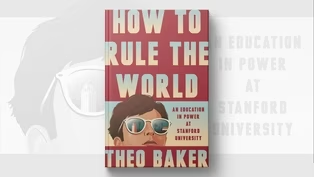
New book explores Stanford's ties with Silicon Valley
Video has Closed Captions
'How to Rule the World' exposes Stanford's complex relationship with Silicon Valley power (8m 52s)
New Mexico law bars armed federal agents at polls
Video has Closed Captions
New Mexico secretary of state explains law barring armed federal agents at polls (6m 59s)
News Wrap: Arts commission approves design of Trump's arch
Video has Closed Captions
News Wrap: Arts commission approves design of Trump's 250-foot arch (7m 35s)
What Colbert's exit means for the future of late-night
Video has Closed Captions
What Stephen Colbert's exit means for the future of late-night (9m 26s)
Providing Support for PBS.org
Learn Moreabout PBS online sponsorship New Episode
- News and Public Affairs

Today's top journalists discuss Washington's current political events and public affairs.

- News and Public Affairs

FRONTLINE is investigative journalism that questions, explains and changes our world.
 New Episode
 New Episode
 New Episode


 New Episode
 New Episode
 New Episode
 New Episode
 New Episode
Support for PBS provided by:
Major corporate funding for the PBS News Hour is provided by BDO, BNSF, Consumer Cellular, American Cruise Lines, and Raymond James. Funding for the PBS NewsHour Weekend is provided by...